Uzma Jilani Urges Saudi Arabia to Build Traceable DRG Payment Decisions
At HealthDataCon 2026, Uzma Jilani outlined how Saudi Arabia can learn from U.S. DRG payment complexity by linking clinical accuracy, explicit exceptions, contract rules and auditable payment decisions.

A hospital payment can be calculated correctly and still be difficult to explain. The diagnosis-related group may be valid, yet a contract clause, an exception or a different rules version can leave payer and provider disputing the result. At HealthDataCon 2026, Uzma Jilani argued that avoiding those disputes requires designing the evidence behind payment alongside the payment method itself.
Jilani, MBA, eFACHDM, senior director of data strategy at NavvisHealth, according to the conference program, presented “The Mistakes We Made First: Casemix, Coding and What the Gulf Can Skip.” Drawing on her experience across payer and provider data operations, she explored what Saudi Arabia could learn from the operational complexity surrounding U.S. DRG payment.
“The question is not only whether a claim groups successfully,” she said. “It’s whether the payment decision can be defended and reproduced.” Her proposed destination was trusted payment intelligence: a traceable connection between clinical documentation, classification, contractual rules, exceptions and the final payment response.
Treat DRG payment as an operating system
Diagnosis-related groups classify inpatient cases into categories used in payment. Medicare’s inpatient system, for example, assigns cases to DRGs with weights reflecting relative resource use. Payment also incorporates other adjustments. A grouping result is therefore an important input to payment, rather than a complete explanation of every amount paid.
Jilani urged participants to think of DRG implementation as an operating system for inpatient payment. It changes documentation practices, incentives, contracting, denials, audit work and cost measurement. Treating the project as a coding installation leaves those interactions to be resolved later, often through disputes.
Saudi Arabia has its own context. The Council of Health Insurance describes AR-DRG, the Australian Refined Diagnosis Related Group system, as supporting value-based healthcare in the Saudi health insurance market. That is a different classification framework from Medicare’s MS-DRGs. U.S. experience offers design lessons without making U.S. payment rules interchangeable with Saudi requirements.
Jilani’s focus was the avoidable complexity that can develop around a case-based system: pressure to maximize coded severity, difficult-to-explain exceptions, contract friction, weak cost feedback and dashboards that lack a common, certified payment calculation.
Make clinical accuracy the objective
Severity classification needs to reflect the patient’s documented condition. A clinically supported complication should be captured accurately; unsupported complexity should not be added to improve reimbursement. Undercoding and unsupported upcoding both undermine fair payment and reliable comparisons.
“Clinical documentation improvement should serve as the truth, not a reimbursement target,” Jilani said. Her distinction matters because a higher case-mix index does not, on its own, explain whether patients have become more complex, documentation has improved or coding behavior has changed.
The U.S. coding guidelines provide a relevant example of the underlying discipline: complete and accurate documentation and code assignment require collaboration between the healthcare provider and coder. Those guidelines concern the U.S. ICD-10-CM system; they illustrate the documentation principle rather than prescribing Saudi coding practice.
Jilani proposed pre-bill checks that examine missing documentation, coding changes and eligibility for exceptions before submission. The purpose is to identify inconsistencies while the evidence can still be reviewed, rather than waiting for an adjudication dispute to expose them.
For data leaders, the implication is that reimbursement analytics need clinical context. A rising severity measure should trigger investigation into the underlying cases and documentation. It should not automatically become either a performance success or an allegation of inappropriate coding.
Define what belongs outside the bundle
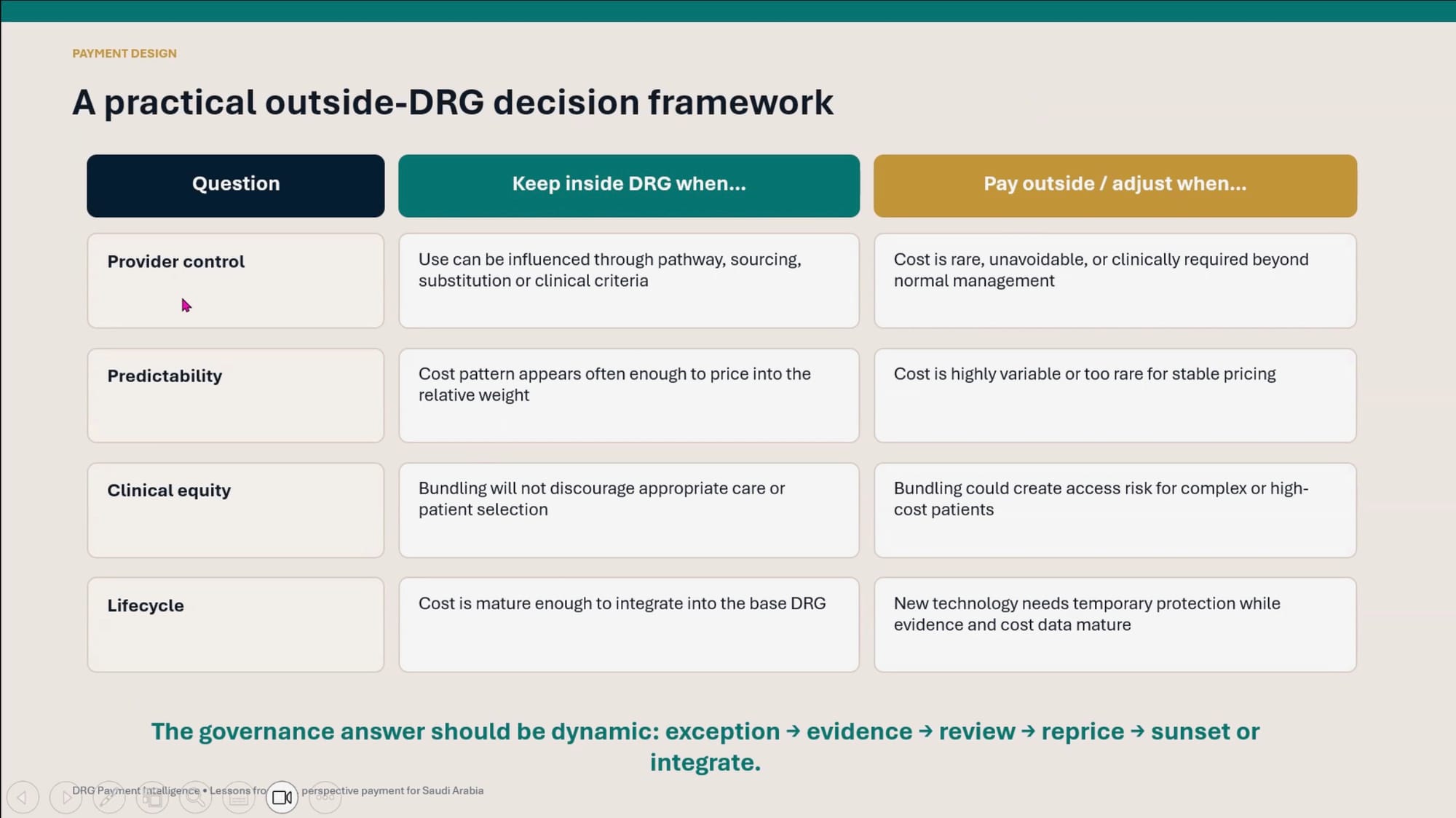
Accurate classification cannot settle every question about unusually expensive care. Jilani described the boundary of a DRG bundle as a policy choice. Predictable services can be reflected in the bundle, while rare costs or emerging technologies may warrant an adjustment or separate treatment under the applicable policy.
She offered four tests: provider control, predictability, clinical equity and lifecycle. Can utilization reasonably be influenced through pathways or sourcing? Is the cost pattern frequent enough to price reliably? Could bundling discourage access for complex patients? Does a new technology need temporary protection while evidence and cost data develop?
The U.S. provides examples of distinct mechanisms. Medicare outlier payments address extraordinarily costly cases that meet specified thresholds. Its technology payments offer an application pathway for qualifying new inpatient services and technologies. These are separate policy mechanisms, not a general entitlement to move expensive care outside a bundle.
Jilani’s proposed governance process would keep exceptions under review as evidence matures. A temporary arrangement should have a review cycle and a decision about repricing, integration or retirement. Otherwise, exceptions can accumulate until the bundle no longer describes the payment system clearly.
Her framework also placed access alongside financial predictability. The test is whether the payment design supports appropriate care for complex patients while making the rationale for additional payment visible and auditable.
Put contract rules into the decision trail
“The goal is a reproducible decision trail and not just a payment number,” Jilani said. Delivering that requires more than a submitted claim. Her proposed data foundation included eligibility, clinical documentation, diagnosis and procedure codes, length of stay, discharge status, transfers, resource use and high-cost items.
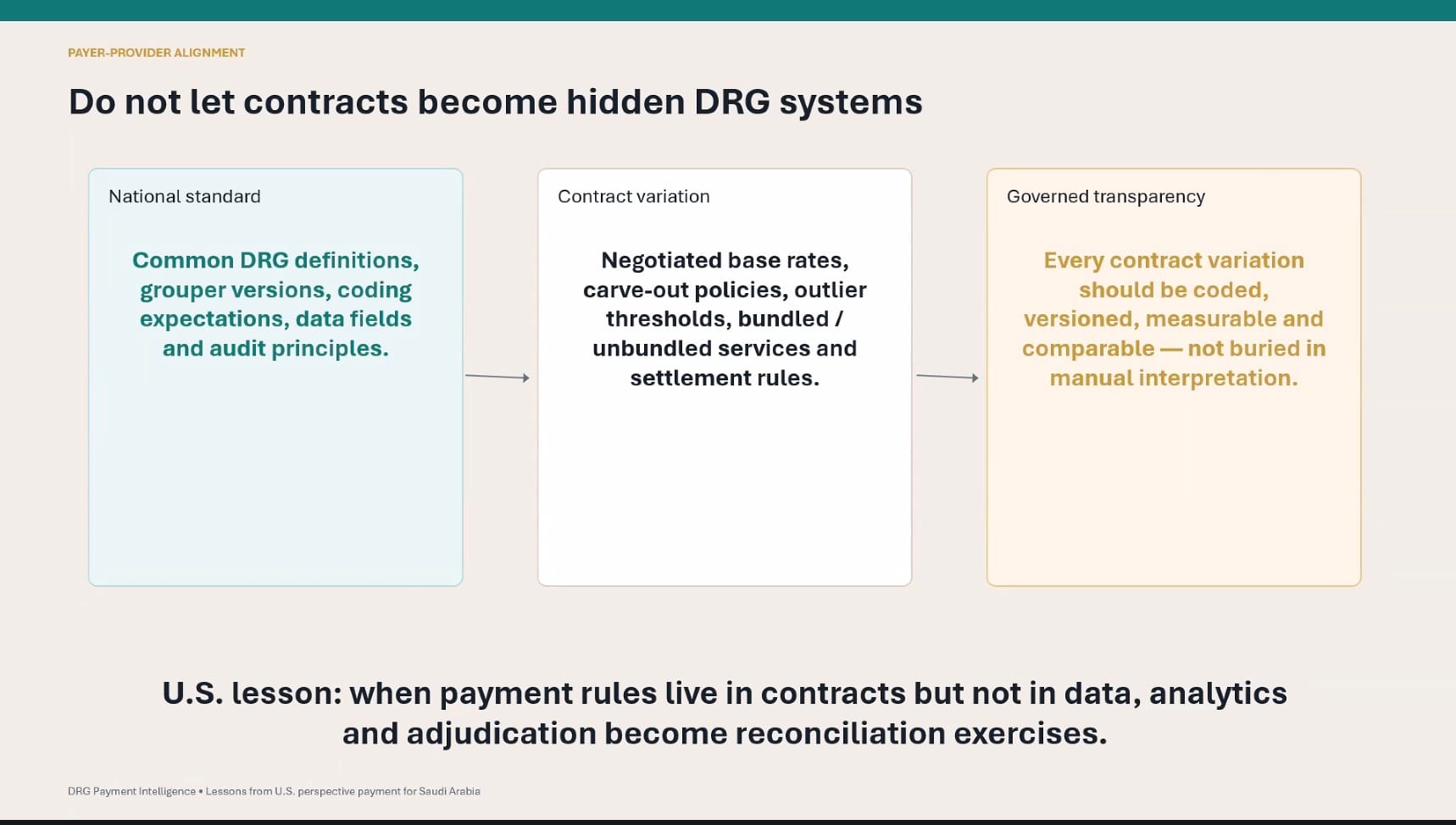
It also included the grouper version, contract terms, exceptions and payer responses. Versioning is consequential: CMS maintains classification software and definitions for successive MS-DRG releases. Reproducing a historical result requires identifying the rules that applied to that case, rather than simply rerunning it through whatever software is available today.
Jilani cautioned that common standards can coexist with negotiated differences. Base rates, outlier thresholds and carve-outs may vary across agreements. The danger is leaving those differences buried in manual interpretation, without effective dates or a version history.
Her operational controls combined pre-bill validation, approval of payment rules, expected-versus-actual variance review, an exception review board and an audit evidence pack. That pack would keep the documentation, coding logic, contractual rule and payment rationale together.
When expected payment differs from the adjudicated result or remittance, the investigation should identify whether the cause lies in coding, versioning, a contract clause or adjudication. A variance category that points to an owner and evidence gives teams a way to resolve recurring problems.
Build controls before complexity accumulates
Jilani proposed a phased implementation roadmap. The first 90 days would inventory rules, carve-outs, outlier criteria, contract variations and data gaps, while defining how outside-DRG decisions should be evaluated. Months three through six would develop expected-payment calculations, pre-bill checks, variance categories, evidence packs and rule approval workflows.
The six-to-12-month phase would establish monitoring, exception reviews, sunset decisions and feedback into pricing. “These are illustrative maturity phases, not claims about current Saudi readiness,” she emphasized. The timetable was a planning framework, not an assessment of national implementation progress.
Her warning indicators included case-mix drift, concentrated outlier costs, expected-versus-paid differences, the share of payment moving outside the bundle, denial and appeal rates, and whether temporary exceptions were actually being reviewed.
These measures become useful when they lead to decisions. A growing denial rate might reveal unclear rules or missing evidence; a concentration of outliers might warrant closer examination of service mix, costs or contractual treatment. The dashboard should guide investigation without substituting for it.
Jilani closed by inviting payers, providers, regulators and technology teams to build the system together. Her central lesson was to connect clinical accuracy, explicit bundle boundaries, governed exceptions and traceable payment decisions from the beginning. That gives both sides of a payment dispute a shared starting point: the evidence and rules that produced the result.