Pooja Mishra Shows How Informatics Makes AI Tumor Board Summaries Useful
Opening HealthDataCon’s EMEA region, Pooja Mishra described how workflow design, source traceability and shared accountability helped Stanford bring AI chart summaries into thoracic tumor-board preparation.
A tumor board can have an abundance of records and still lack the patient context needed for a useful discussion. Years of treatment, imaging, pathology and molecular findings must become a coherent account before specialists can consider what happens next. Compressing that history is consequential work: a shorter account helps only if it preserves what matters.
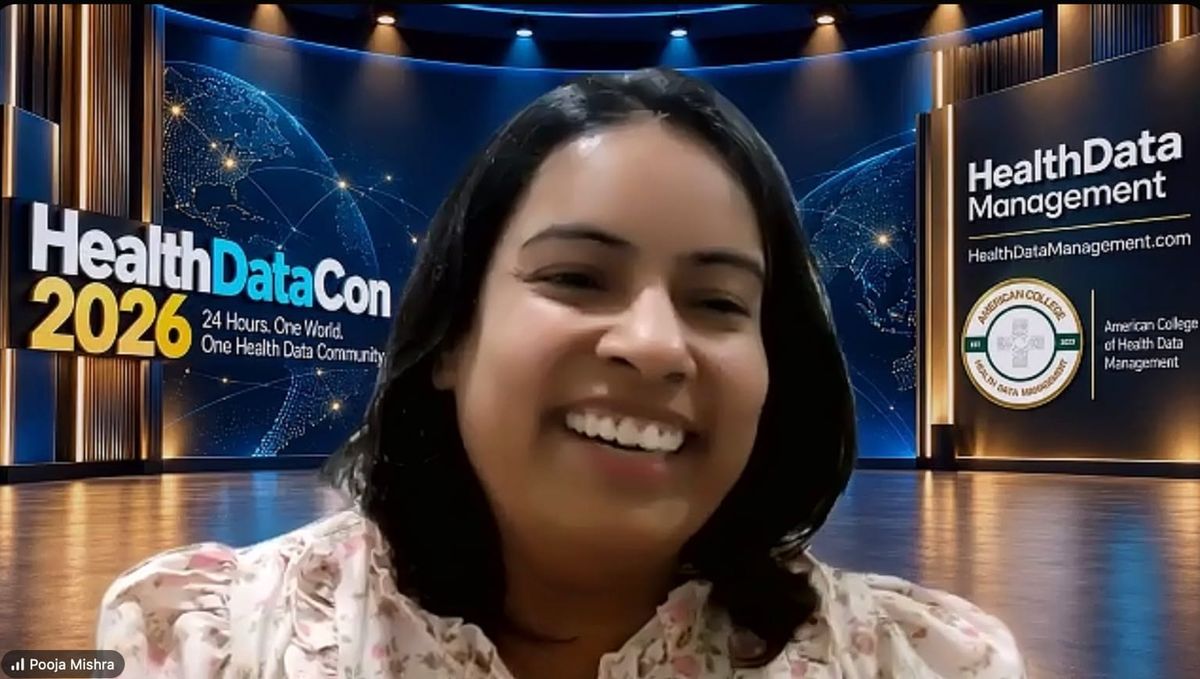
Opening HealthDataCon 2026’s Europe, Middle East and Africa region with her second presentation, Pooja Mishra described Stanford Health Care’s approach to AI chart summarization for oncology tumor boards. Her central lesson concerned the work around the model: defining the clinical question, connecting records, validating outputs and keeping responsibility with clinicians.
The case study offered a practical account of moving from manually assembled AI assistance to summaries generated within an established clinical workflow. It also drew a boundary around the evidence. Early physician feedback supported continued development; the presentation did not establish that the intervention improved treatment decisions or patient outcomes.
Define what the board needs to decide
Mishra described a thoracic tumor board reviewing 12 to 20 complex cases in a single hour. Each case might involve years of care across physicians and health systems. Different specialists needed different details, and the interval between a clinic visit and the board discussion could introduce further gaps in shared understanding.
The earlier workflow combined a recent note with an AI prompt. Its limitation was straightforward: information absent from that note might never reach the summary. Manual preparation and review remained substantial, while the question the tumor board needed to answer was not always captured well.
The team therefore changed its starting question. Rather than asking what a model could summarize, it examined what clinicians needed to discuss a patient safely and efficiently. Informatics staff investigated preparation habits, information sources, cognitive burden and the clinical elements that warranted attention.
This approach has a broader foundation in AHRQ’s toolkit, which helps organizations assess how health IT affects clinical and administrative workflows. Mapping the work makes it possible to identify where technology helps and where a new process might create additional burdens.
For a tumor board, that means specifying the purpose of the summary before optimizing its length. An account of the treatment course, the evidence supporting a diagnosis and an unresolved question serve different functions. A fluent narrative can obscure those distinctions unless the output is designed around them.
Build automation in stages
Mishra’s presentation traced a staged progression: secure generative AI assistance in January 2024, broader clinician access to Stanford’s internally developed chart-interaction platform in September 2025, and automated thoracic tumor-board summaries returning to the electronic health record in January 2026.
These were milestones in the workflow she described, rather than a claim that the underlying technology first appeared on those dates. Stanford’s June 2025 public account had already described ChatEHR and its use for querying and summarizing medical records. The platform connects language models with clinical data; it should not be confused with a newly invented foundation model.
In the final workflow presented, tumor-board registration triggered summary generation and the output returned to the EHR. Clinicians did not need to remember to visit a separate application. The automation concerned preparing and delivering information. Diagnosis and treatment deliberation remained with the clinical team.
Each stage also created a chance to learn. The initial process exposed input limitations; subsequent work addressed access to patient context, output presentation and integration. Moving directly to unattended generation would not have answered those workflow questions.
The organizational responsibilities were equally specific. Clinical informatics defined requirements and validation needs. The oncology EHR team supported scheduling and presentation. Data scientists worked on prompts and the platform, while integration specialists connected the systems. Shared accountability gave the work continuity across those boundaries.
Keep evidence and uncertainty visible
In the discussion after her presentation, Mishra was asked which information should remain traceable to its original source. Her answer was expansive: everything needed that connection. A generated account should help clinicians reach the underlying evidence, while preserving their responsibility for interpreting it.
That distinction becomes especially important when pathology, imaging and clinical notes disagree. Mishra said unresolved questions should return to the experts in the room. A summary that silently smooths over a discrepancy could remove the very issue the board needs to examine.
For organizations applying this lesson, the practical design question is whether a reviewer can distinguish documented findings, historical statements and unresolved uncertainty. Dates and sources can matter as much as the sentence itself. A prior assessment should not become a current conclusion merely because it appears in polished prose.
The World Health Organization’s AI guidance warns about inaccurate or incomplete outputs and the risk of automation bias. It also calls for stakeholder involvement from early development. Those concerns make source access and meaningful review part of the operating design, rather than assurances added after deployment.
Mishra’s emphasis was on clinicians remaining in charge of the information and the decision. Simply putting a person beside an AI output does not explain what that person must check, how discrepancies become visible or how corrections feed back into the system.
Measure more than faster preparation
The presentation described favorable early feedback from physicians in the thoracic tumor-board cohort. Mishra identified it as local, unpublished feedback. The supplied material does not provide a sample size or enough detail to assess the survey’s representativeness, and its percentages should not be treated as evidence of clinical effectiveness.
Asked about benefits beyond efficiency, she pointed to confidence in handling case volume and the possibility of bringing multidisciplinary review to more patients. That is an important operational ambition. It remains different from demonstrating that more cases were actually reviewed without compromising discussion quality.
Research provides useful evaluation dimensions. A 2024 reader study assessed clinical summaries for completeness, correctness and conciseness. Its findings concerned the systems and tasks studied; they do not validate Stanford’s tumor-board implementation. They nevertheless illustrate why speed alone is an incomplete measure.
The DECIDE-AI guideline likewise emphasizes early clinical evaluation, including actual performance and human factors. Applied here, a useful evaluation would examine consequential omissions, correction burden, source-checking effort and whether the summary helps the board address its clinical question. These are evaluation priorities, not outcomes established by this presentation.
Make the operating model reusable
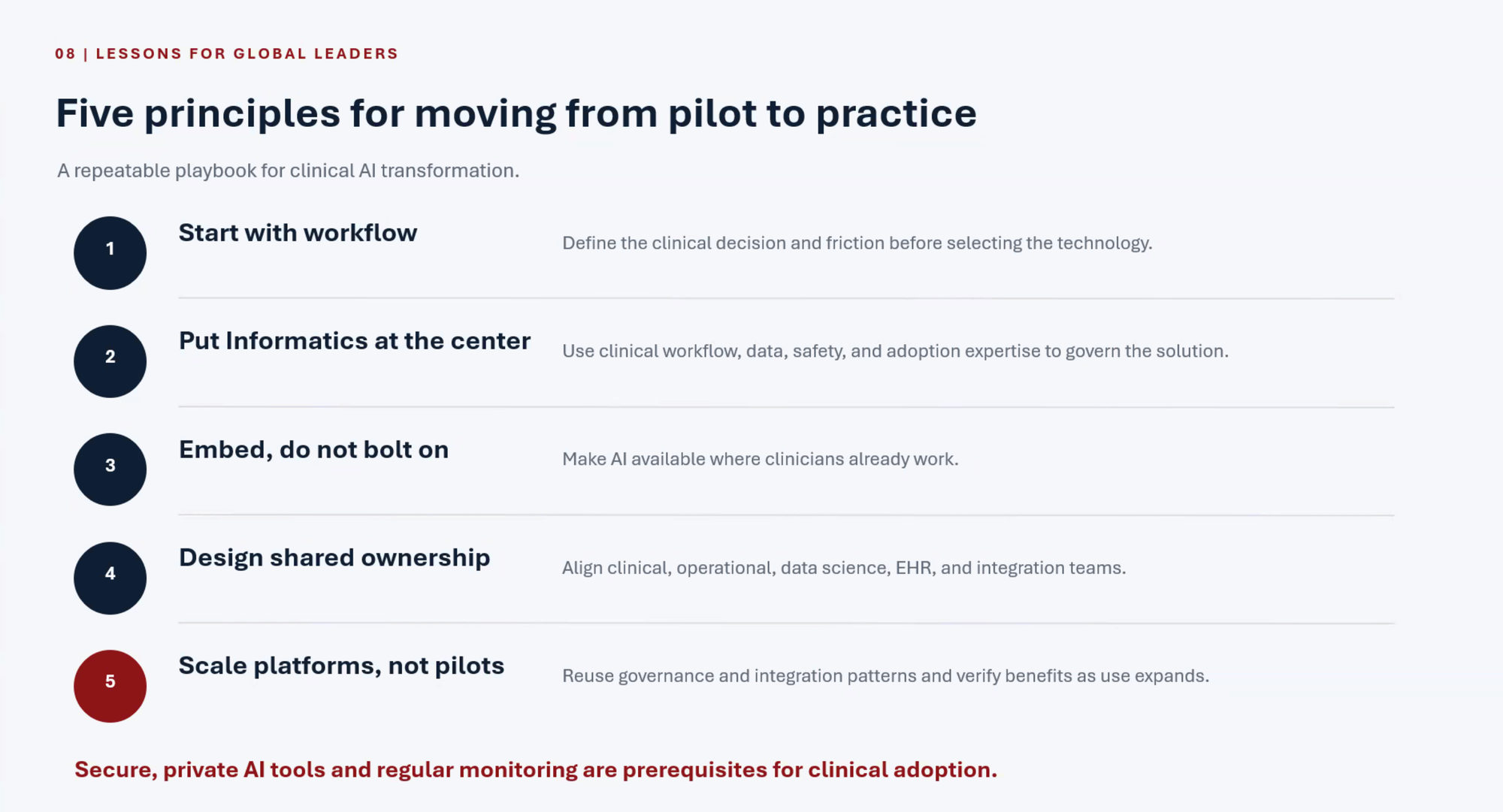
Mishra closed with five principles: begin with the workflow, place informatics at the center, embed AI where clinicians work, establish shared ownership and build capabilities that can support further use cases. The common thread was an organization able to learn from implementation and maintain accountability as use expands.
She identified potential extensions including treatment-history summaries, structured data extraction, trial matching, registry support and referral triage. Her slides explicitly noted that deployment status varies. Each application still needs its own clinical purpose, validation and oversight, even when infrastructure can be reused.
NIST’s voluntary risk framework provides a complementary basis for considering trustworthiness through design, development, use and evaluation. For a health system, that supports treating governance as continuing work rather than a one-time permission to launch.
The lasting contribution of the case study was this operating discipline: make relevant evidence easier to use, retain its connection to the record and keep clinical judgment with the people responsible for care. As Mishra put it, “Technology creates possibility. Informatics creates impact.”