Mallikarjuna Rao Dubisetty Puts Accountable Decisions at the Center of Digital Twins
At HealthDataCon 2026, Mallikarjuna Rao Dubisetty connected digital twins, microsensors and rehabilitation with a practical leadership challenge: validate one use case and name who acts on the results.

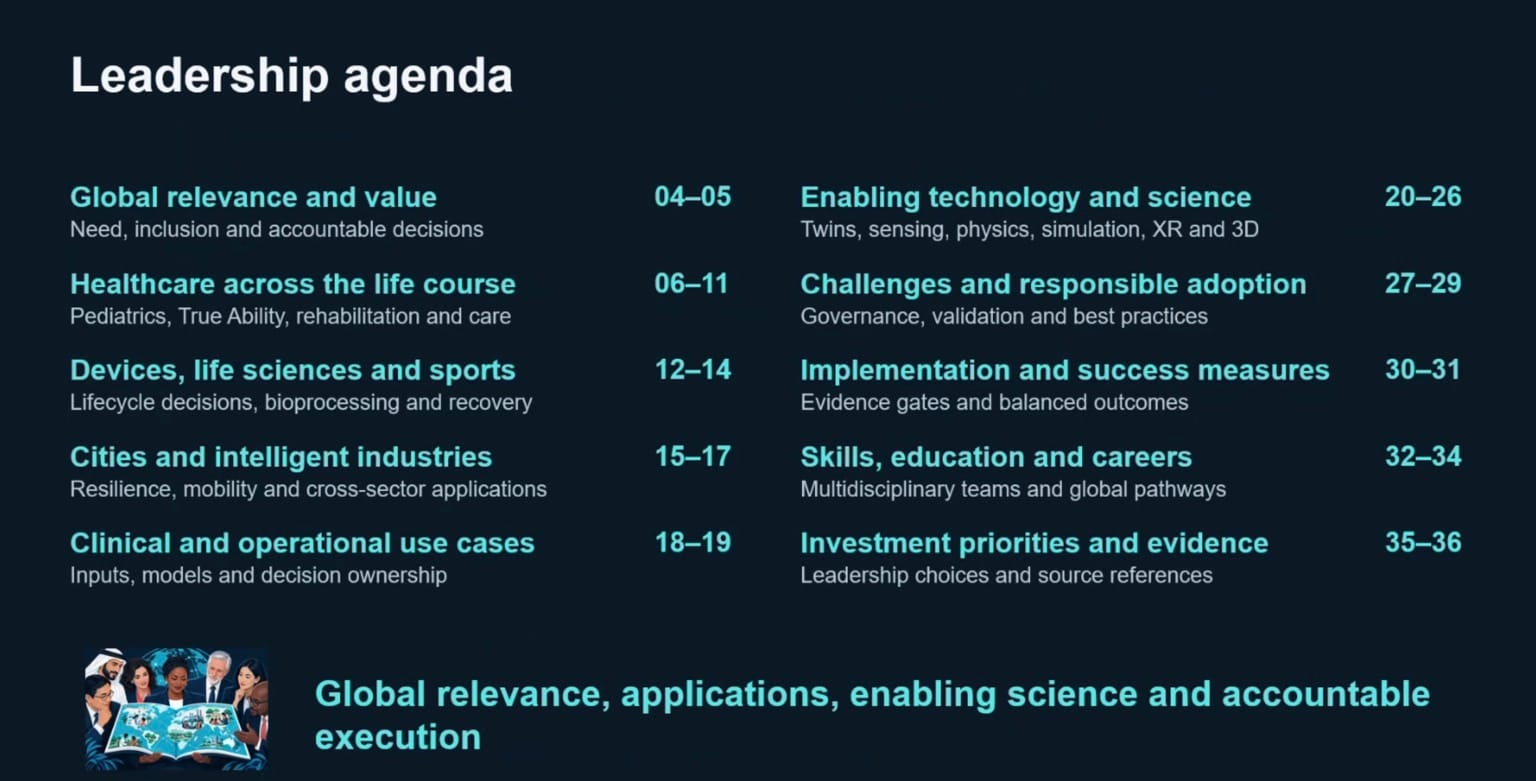
A digital twin becomes useful when it helps someone make a better decision—and when that person can judge whether its recommendation deserves trust. At HealthDataCon 2026, Mallikarjuna Rao Dubisetty brought that practical test to a wide-ranging discussion of digital twins, microsensors and advanced physics.
Dubisetty, PhD, DBA, MBA, PGDEI, eFACHDM, was identified in the conference program as global vice president for the Healthcare & Life Sciences Centre of Excellence at HelixBeat LLC and chairman of the World Autism Society. His session connected rehabilitation, remote care and hospital operations with applications in manufacturing, transportation and infrastructure.
Across those settings, his emphasis remained on reliable observations, a useful model and an accountable response. He presented many examples as illustrative workflows, with their value dependent on validation and human judgment. The ambition was substantial, but the proposed starting point was deliberately focused: select a decision that a team can evaluate and own.
Start with the decision a twin will support
Dubisetty distinguished a static digital model from a representation updated by measurements. In the session’s working definition, a digital twin went further: information supported an action, and the observed response returned to the model. A dashboard or connected device could contribute to that process without, by itself, establishing a digital twin.
That distinction matters for investment. A hospital model designed to compare bed allocation scenarios answers a different question from a patient model designed to explore treatment response. Each requires evidence appropriate to its intended use. A visually compelling representation does not establish that either decision will improve.
The National Academies’ research report similarly describes potential applications in individualized medical decision-making and engineering while identifying substantial research needs. It provides context for the session’s caution: the promise of the field should not be confused with evidence for a particular implementation.
For leaders, Dubisetty’s approach shifts the first conversation toward the decision, the minimum reliable inputs and the person who will review the output. Those choices give a pilot a measurable purpose and prevent a broad technology demonstration from becoming its own justification.
Make function and participation the purpose
Rehabilitation and inclusion occupied a central place in the presentation. The scale of need is considerable: WHO estimates that about 2.4 billion people have conditions that may benefit from rehabilitation, while approximately 1.3 billion people experience significant disability. These describe different, overlapping populations and should not be added together.
Dubisetty explored how movement, pressure and posture measurements might help a therapist and a patient compare assistive-device settings. In a wheelchair example, the question was whether a different configuration could improve comfort and function. Sensor output would inform that conversation alongside the user’s preferences and the therapist’s assessment.
“It cannot define a child’s potential,” he said of a model’s limits. His discussion of children emphasized growth, changing needs and continuing review. A model suitable at one developmental stage may require reassessment later; adult assumptions cannot simply be carried into pediatric care.
Access also belongs in the design. WHO’s assistive technology guidance describes products that support functioning and participation, together with major access inequities. In the session, assisted onboarding and alternative service routes were practical ways to avoid assuming everyone could use the same wearable or digital interface. Success meant meaningful participation, with dignity and choice preserved.
Connect remote observations to a response
Remote monitoring offered another example of the distance between collecting data and delivering care. Dubisetty described a heart-failure workflow that established a personal baseline, checked changing measurements and brought a nurse into the process to confirm symptoms before action under an agreed protocol.
The response might involve a consultation, a home visit or escalation. The important connection was between the signal and a service capable of responding. His examples were proposed care pathways, rather than evidence that a particular device or model had reduced admissions or improved survival.
“The relationship between doctor and patient still remains as it is,” he said. “Technology is the only utility.” In context, his point was that the technology serves the care relationship and supplies information for professional judgment.
During questions, he extended that argument to recovery after discharge. Monitoring could help a team understand how someone was progressing through rehabilitation at home. The organization would still need to determine who reviews observations, when review occurs and what happens when information is missing or concerning.
FDA’s remote-data guidance addresses digital technologies used to collect information in clinical investigations. Its scope is research, rather than blanket endorsement of routine care applications. That boundary reinforces a useful discipline: evidence must match the setting and purpose for which the technology will be used.
Test the measurements and the model
Dubisetty repeatedly returned to the quality of the observations feeding a model. Motion artifacts, calibration changes, battery limitations and sensor drift can affect interpretation. A loose sensor may produce an apparent change that requires checking the measurement before treating it as a change in the patient.
His account separated verification from validation. Verification examines whether the implementation works as intended; validation examines whether the model is suitable for its proposed use. Comparing output with independent measurements, describing uncertainty and reviewing subgroup performance were parts of the evaluation he advocated.
FDA’s modeling guidance provides a risk-informed framework for assessing computational modeling and simulation in medical-device submissions. It applies to physics-based, mechanistic and other first-principles models. It should not be read as a general approval of every digital twin or AI system.
Physics can help explain the mechanisms behind measurements: forces and movement in biomechanics, for example, or temperature changes in a cold-chain investigation. But a plausible mechanism still needs evidence that the model performs adequately for the decision under consideration.
Dubisetty warned that a technically sound system could still fail when “alerts overwhelm staff” or nobody owns the response. His recommendations included monitoring drift, assigning escalation responsibility and maintaining rollback and downtime procedures. A validation exercise therefore needs to examine the operational process as well as the software.
Fund a focused pilot with accountable ownership
The presentation ranged across industries, but its investment recommendation was narrow. Begin with a focused use case, establish a baseline, identify an accountable owner and evaluate results prospectively. Broader connections can follow as evidence develops.
Dubisetty also argued for balanced measures. Earlier detection or improved function should be examined alongside missed events, false alarms, adverse outcomes and workload. A system that produces more observations may create additional burden unless the team has the capacity and authority to respond.
“Co-design with users and caregivers should continue throughout the lifecycle,” he said. That makes participation an ongoing responsibility, including when a device becomes uncomfortable, a workflow becomes difficult or a person’s circumstances change.
The choice of comparator also matters. Dubisetty called for simpler alternatives to remain part of the assessment. A team considering a sensor-driven model should ask whether an existing workflow, a better reporting process or a less complex tool could achieve the same purpose. That comparison makes the added value of modeling visible and helps distinguish benefits attributable to the technology from improvements produced by greater attention to the underlying service.
For health data leaders, the session offered a concrete investment question: which decision could a model improve, and what evidence would demonstrate that improvement? Answering it requires clinicians, users, engineers, data specialists and governance leaders to work together. The first deliverable is a credible connection between observation, judgment, action and measured results.