Moses Landon and Matt McGirt Connect Healthcare AI Value to Workflow Ownership
At HealthDataCon 2026, Moses Landon and Matt McGirt explained how clinical and revenue teams can turn AI output into action through shared workflows, physician review and realistic measures of impact.

An AI system can summarize a medical chart in seconds. Whether that summary helps a patient receive care, prevents an authorization delay or improves reimbursement depends on the people and processes that act on it.
That was the central argument from Moses Landon and Matt McGirt at HealthDataCon 2026. Their session, “The Model Reads the Chart. Someone Still Has to Run the Workflow: Measuring Speed-to-Impact When AI Enters the EHR,” examined the distance between generating information and producing a measurable result.
The conference program identified Landon, MBA, EHRC, SA, eFACHDM, as head of revenue at Carolina NeuroSurgery & Spine Associates, and McGirt, MD, FAANS, as a neurosurgeon and chief medical officer. McGirt’s clinical practice spans minimally invasive spine surgery through complex spinal reconstruction. Together, they described an operating partnership that brings clinical judgment and revenue cycle expertise into the same decisions.
Start with the decision that needs to change
Landon framed AI as a companion to experienced clinicians and operators. His test for a proposed use case begins with identifying who receives the output, what that person does differently and which existing performance measure should improve.
“If you cannot name the decision that comes out different, you cannot measure it,” he said.
The distinction matters when organizations evaluate AI features inside an electronic health record. A useful summary can still leave the next task untouched. Someone must assemble the authorization packet, resolve missing documentation, validate coding or investigate a denial. If ownership remains unclear, faster information retrieval can simply move work into another queue.
That emphasis is consistent with AHRQ’s workflow toolkit, which treats both clinical and administrative workflows as central to successful health IT implementation. Landon’s examples brought that principle into the AI purchasing conversation: assess the organization’s EHR configuration, existing automation and process gaps before deciding what another tool will add.
He identified six areas between the chart and the result: documentation specificity, attribution and credit integrity, prior authorization, claim construction, payer-side AI review and denial intelligence. Each requires its own controls. A claim can pass technical edits while still assigning credit incorrectly, he cautioned.

Bring authorization knowledge to the point of care
McGirt used complex spine care to illustrate why the clinical and financial teams need to work together. Surgeons may know the diagnosis and treatment options intimately while having limited visibility into changing payer documentation requirements, code combinations and modifiers.
His proposed response was to make relevant requirements available when the clinician is making a decision. A tool could identify the patient’s payer, surface applicable documentation needs and help the team determine whether supporting records are present before an authorization request moves downstream.
“It needs to be a sensory neuron and a motor neuron,” McGirt said, describing a system that helps inform action as well as read information.
This was a design direction, rather than evidence that every capability described was already deployed. There is also an existing standards foundation for part of the problem: HL7’s DTR guide describes how payer documentation requirements can be represented computably and used in provider workflows. Connecting those requirements to usable clinical processes still requires implementation and oversight.
For McGirt, documentation quality extends beyond what a surgeon dictates during one visit. Imaging, physical therapy records, injection notes and other relevant treatment history may sit across several organizations. Bringing that history together can support both clinical decision-making and the evidence needed for authorization.
The shared objective is an accurate account of care. Missing evidence and care that has not occurred are different problems; neither should be resolved by generating unsupported documentation.
Earn trust through review and useful feedback
The speakers argued that clinicians need visible benefits from implementation. If physicians experience only new requirements and deployment problems, enthusiasm can fade even while administrative teams gain efficiencies.
McGirt proposed giving surgeons timely, understandable feedback about coding and reimbursement. A case summary could explain which codes were used, which modifiers applied and which services a particular payer did not cover. Such feedback could help clinicians understand outcomes that otherwise appear as unexplained changes in credit or payment.
“Then that builds trust through education,” he said.
An audience question exposed an important distinction in the presentation. The slides described restrictive boundaries around chart-writing, but McGirt said he already uses AI-generated documentation in his own practice. He described recording an encounter through an Epic-connected workflow, then reading, revising and shaping the resulting note.
That account supports a distinction between drafting with clinician review and autonomous chart action. It does not establish that generated notes are error-free. Microsoft’s review guidance for DAX Copilot in Epic likewise describes reviewing generated content before finalizing a note, including comparing the note with the transcript.
Verifying a summary of months of outside records presents a broader challenge than reviewing a conversation the physician just attended. McGirt pointed toward that next challenge, but the session did not provide a validated protocol for detecting omissions without rereading the underlying chart. That remains an important evaluation question for teams adopting longitudinal summaries.
Measure the journey from output to outcome
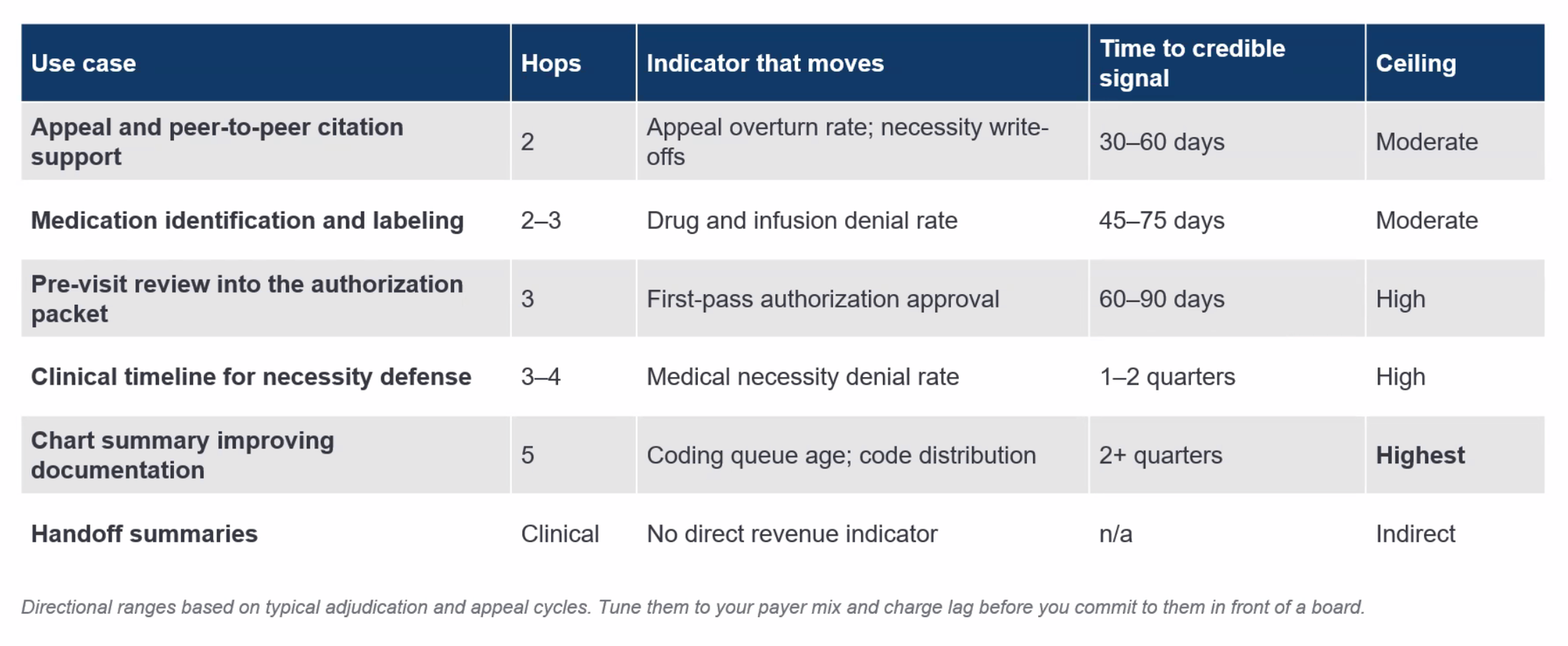
“How many hands sit between the output and the dollar?” Landon asked.
His point was that different use cases have different routes to value. A documentation tool may change clinician behavior before that change appears in coding, claim submission, adjudication and payment. An appeal-support tool operates much closer to an existing financial dispute.
The presentation’s measurement slide offered directional ranges: 30 to 60 days for a credible signal from appeal and peer-to-peer citation support, 60 to 90 days for pre-visit review feeding authorization packets, and two or more quarters for chart summaries improving documentation. The slide explicitly called for adapting those ranges to local payer mix and charge lag. They were planning estimates, not reported trial results or guaranteed returns.
Landon cautioned against treating a short adoption window as proof of downstream financial impact. Teams need baselines, defined outcomes and enough follow-up to observe the relevant cycle. Useful indicators might include first-pass authorization approval, coding queue age, denial rates and appeal outcomes.
Their process also includes jointly assessing risk, agreeing on pilot governance and deciding whether observed results justify continuing. That approach aligns with the multidisciplinary, ongoing risk management described in NIST’s framework. Governance continues as systems and working conditions change.
Make the patient benefit visible
When an audience member asked whether automation on both the payer and provider sides could help patients, McGirt brought the discussion back to uncertainty and delay. Earlier visibility into authorization requirements could help a physician explain the next steps during the visit, rather than leaving the patient to learn about a problem weeks later.
That transparency has a policy counterpart. The CMS rule on interoperability and prior authorization requires affected payers to provide specific denial reasons for non-drug prior authorization decisions beginning in 2026. Its scope is defined; it is not a universal rule for every payer or service. Clear reasons can help teams understand what a resubmission or appeal must address.
The speakers did not present measured patient-experience gains from their proposed workflows. They did describe a concrete opportunity: bring the relevant information into the conversation earlier, explain barriers clearly and give staff responsibility for resolving them.
McGirt also saw the current interest in AI as an organizational opening. “Everyone seems to agree there’s an opportunity here to stop, pause, reflect, and join to a common goal and aim,” he said.
For Landon and McGirt, that common goal becomes practical when clinicians, coders and operators select a decision together, establish the baseline and follow the result through the workflow. The value of the model becomes visible in what the team can reliably do with its output.