Mohamed Ghaleb Connects Clinical Governance From the Boardroom to the Bedside
At HealthDataCon 2026, physician Mohamed Ghaleb explained how clinical governance can connect bedside concerns, reliable data and executive decisions—and how leaders should verify that action improves care.
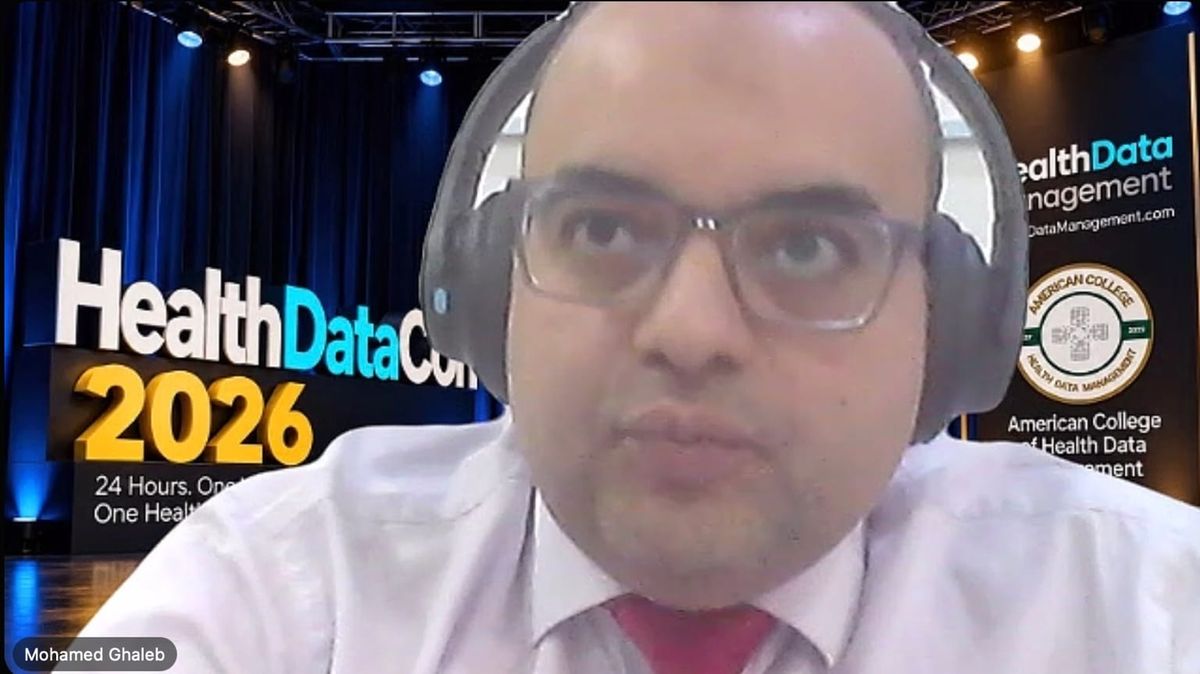
The boardroom dashboard is green. Elsewhere in the hospital, a nurse is struggling to secure timely help for a patient. Mohamed Ghaleb opened his HealthDataCon 2026 presentation with that imagined disconnect: executives can believe an organization is performing well while the experience of care tells another story.
Ghaleb, MD, MSc, MHSA, eFACHDM, a physician and senior health services leader at Saudi Arabia’s Health Holding Company, presented “Breaking the Silos: Clinical Governance from theory to Practical Implementation.” His central argument was that clinical governance must connect what happens at the bedside with decisions made in the boardroom, and carry those decisions back into practice.
Reliable data makes that connection possible. Leadership, clear authority and a culture in which staff can report concerns determine whether the connection produces action.
Bring clinical quality into the boardroom
Ghaleb situated the discussion in the development of clinical governance in the United Kingdom. The foundational 1998 paper by Gabriel Scally and Liam Donaldson addressed a familiar imbalance: financial matters and activity targets had come to dominate management agendas. Their argument connected clinical quality, service performance and financial control across the organization.
For Ghaleb, that history explains why accountability belongs at the center of governance. A hospital needs a system that enables people to identify problems, assign responsibility, improve services and protect patients. A committee’s existence does not establish that those functions are working.
He also emphasized that implementation must respond to local organizational conditions. Australia’s governance standard, for example, gives governing bodies explicit responsibilities for defining roles, monitoring responses to incidents and reviewing safety and quality performance. It also places patient partnership within leadership’s responsibilities.
That broader view shaped Ghaleb’s account of implementation in Saudi Arabia. Clinical governance requires participation from executives, clinicians, patients and finance teams. Assigning it exclusively to a quality department or medical director leaves other decision makers disconnected from the work needed to improve care.
Build ten pillars with clear owners
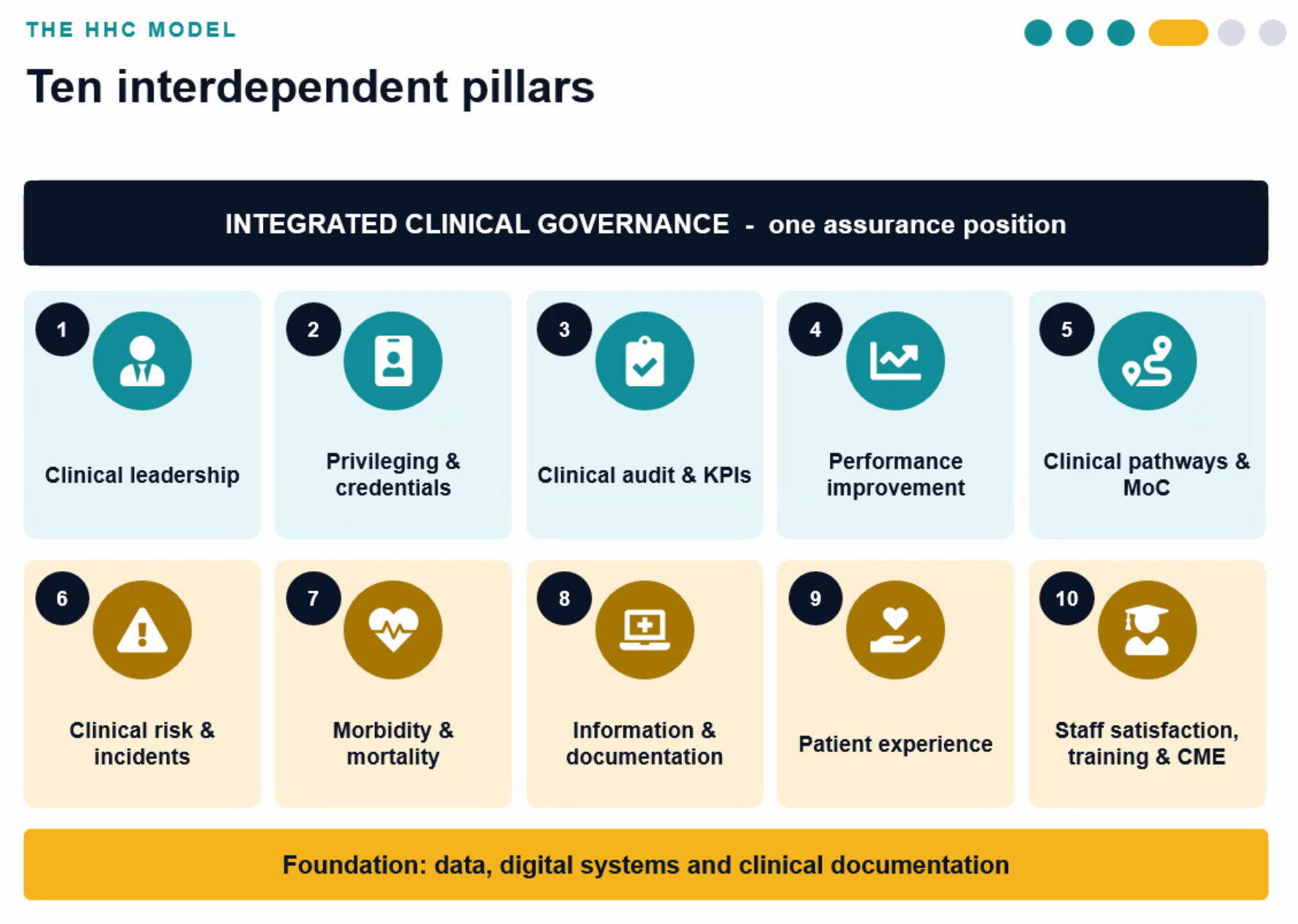
The HHC model he presented has ten interdependent pillars: clinical leadership; privileging and credentials; clinical audit and key performance indicators; performance improvement; clinical pathways and the model of care; clinical risk and incidents; morbidity and mortality; information and documentation; patient experience; and staff satisfaction, training and continuing medical education.
Each pillar needs six practical components: a named accountable lead, policies and procedures, performance measures, a record of risks and actions, a monthly assurance statement and a defined reporting route. Together, those components establish who must act and what evidence should reach decision makers.
Ghaleb described a sequence that began with agreement on the purpose of governance, followed by development of individual pillars and then integration. He advised leaders to begin with local examples of care gaps, engage colleagues, agree on decision rights and secure board endorsement. During the first three months, organizations can establish responsibilities, reporting calendars and delegated authority.
The clinical work should also start at a manageable scale. A few priority audits and pathways can be developed, measured and improved before expanding the portfolio. His pathway examples crossed levels of care, consistent with HHC’s published care model, which emphasizes integrated services and transitions between facilities. Writing a protocol is only the beginning; staff need training, monitoring tools and usable data.
He described monthly sampling for audits of venous thromboembolism prevention, examining assessment, prescribed care and outcomes. Early work could begin with manual spreadsheets. The essential requirement was confidence in the underlying clinical information and a process for using the findings. Pillars needed time to mature before leaders could rely on their combined reports.
Follow one signal across the system
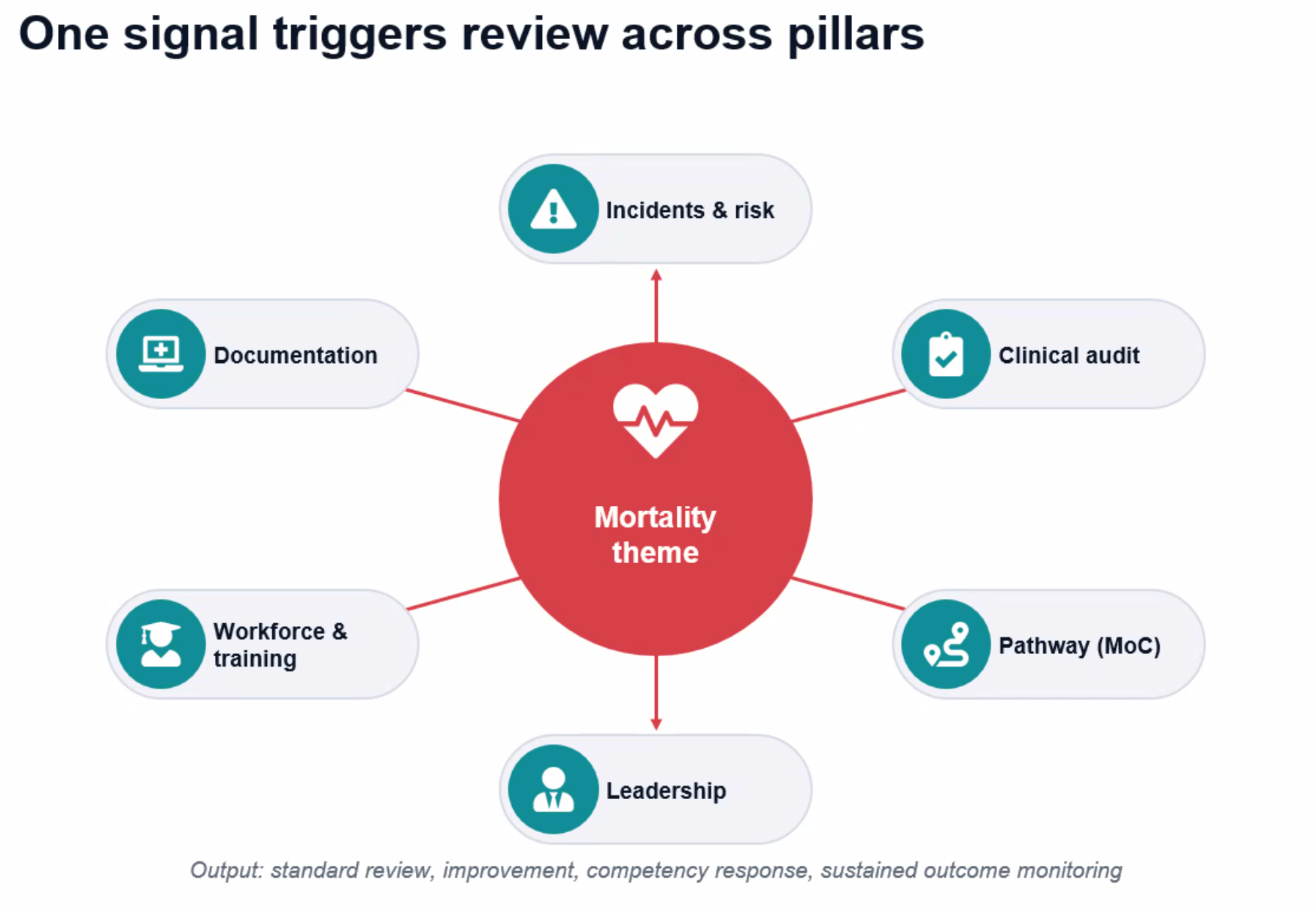
To explain integration, Ghaleb offered an illustrative rise in neonatal mortality. A governance committee should bring together evidence from several pillars: the relevant pathway, staffing and skills, clinical privileges, audit findings, documentation, incident reports and families’ experiences.
That combined review can help determine whether the response requires additional resources, changes to practice, competency development or another intervention. A mortality figure alone cannot identify which action will address the underlying problem. The purpose of integration is to make the decision better informed.
He applied the same reasoning to clinical privileges. Credentialing should contribute to an ongoing assessment of whether clinicians have the capabilities and authorized scope needed for the services they deliver. Reviewing it alongside clinical performance makes it part of improvement rather than an isolated administrative exercise.
Ghaleb was candid about the remaining technical challenge. Information still arrives from different systems, and he described the absence of a single platform integrating the relevant governance data. Connecting incident reporting, mortality reviews, privileges and other information remains an opportunity. His presentation was an implementation account, not evidence that a unified platform had already been delivered or that the model had produced a measured reduction in mortality.
Match escalation to authority and urgency
In the operating structure Ghaleb described, concerns move from daily departmental discussions into weekly reviews, hospital governance and monthly reporting to the cluster or corporate level. Unresolved issues requiring broader support move upward, while urgent incidents have faster escalation routes.
The audience pressed him on where decisions should sit. A department can act within its delegated authority. Recruiting additional specialists may require corporate funding, while opening a major new service can require board approval. Written decision rights make those boundaries visible before a problem stalls between departments.
Reporting and escalation serve related purposes. Patient safety concerns should enter the reporting system; their severity, urgency and resource requirements help determine the level of response. Higher leadership still needs visibility into decisions and improvement work undertaken locally.
None of that works if staff fear reporting concerns about a colleague or procedure. Ghaleb repeatedly returned to culture as a condition for useful information. WHO’s reporting guidance reinforces the need for care in interpretation: incident reports can reveal important patterns, but their limitations must be understood before drawing conclusions about harm.
Patient and family input adds another source of evidence. Ghaleb pointed to shared decisions, experience surveys, complaints and community engagement. Analyzing complaints by specialty, for instance, may expose a staffing problem behind long waits. NHS England’s involvement framework also describes patient participation in organizational safety governance, including committees that review safety data.
Close the loop with evidence of improvement
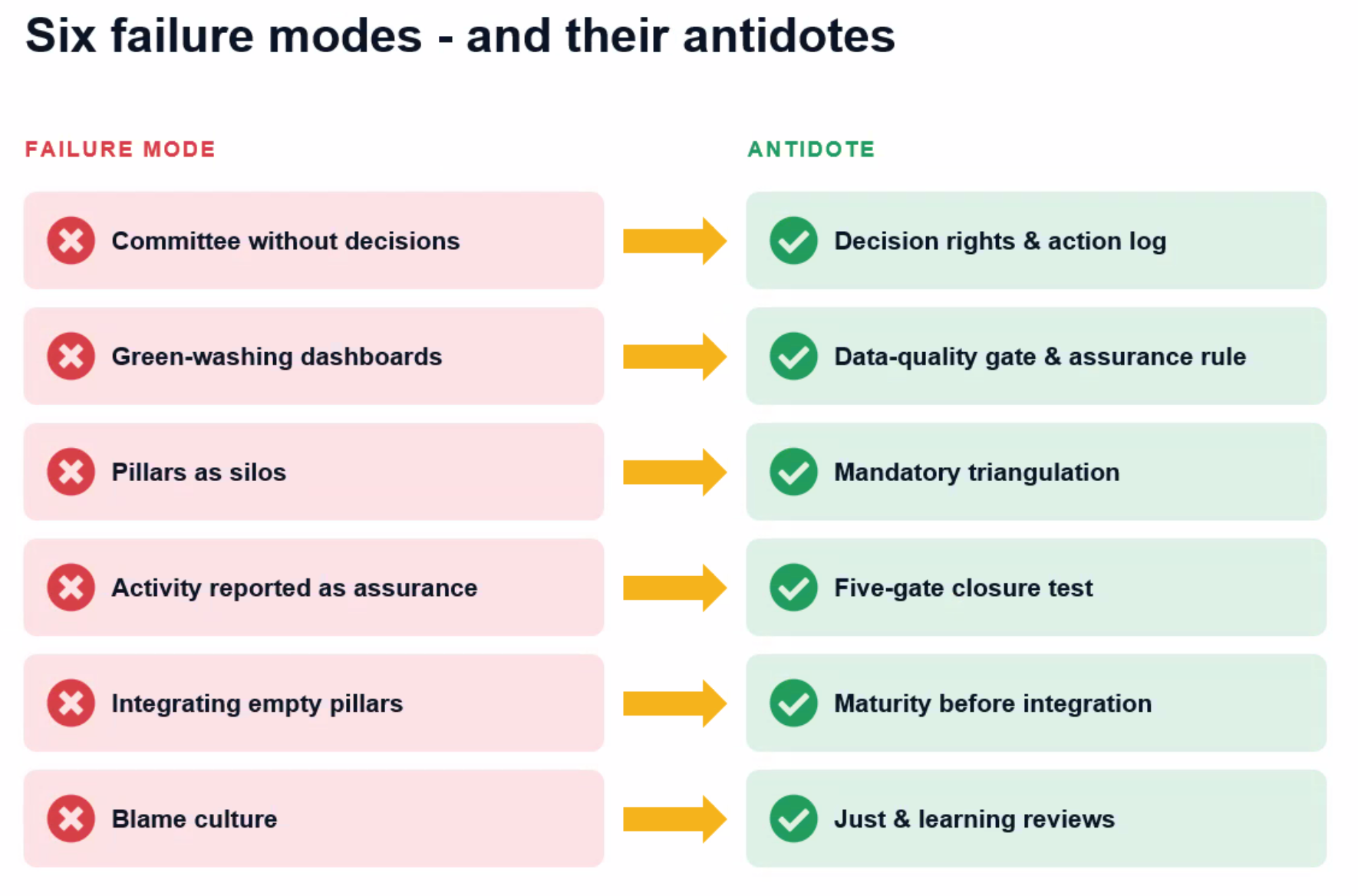
For Ghaleb, completing an action requires follow-up evidence from the relevant pillars. If a response includes training, leaders should also examine whether practice changed, whether pathway performance improved and what subsequent outcome and patient experience data show.
That expectation aligns with NHS England’s incident response safety standards, which call for monitoring both the implementation and effectiveness of safety actions, with a named individual responsible. The distinction matters when a completed task is being offered as evidence that a clinical problem has been resolved.
Asked how to recognize governance that generates meetings without improving care, Ghaleb recommended examining the decisions taken, the improvement projects initiated and their effects on mortality, morbidity and patient satisfaction. He also identified a financial connection: documentation failures can appear in rejected claims, giving revenue cycle teams relevant evidence to contribute.
His answer to what he would stop was direct: unnecessary meetings and nonfunctioning committees. Structures need an environment in which people speak up and leaders act. He closed around three requirements: committed senior leadership, dependable digital and data foundations, and people able to analyze information and use it. The board’s assurance should come from evidence that reaches the patient’s experience of care.