Christopher Besser Outlines a 90-Day Path From Fragmented Data to Action
At HealthDataCon 2026, Christopher Besser introduced a developing framework for community health data, urging leaders to diagnose one broken handoff, establish ownership and demonstrate a useful capability within 90 days.
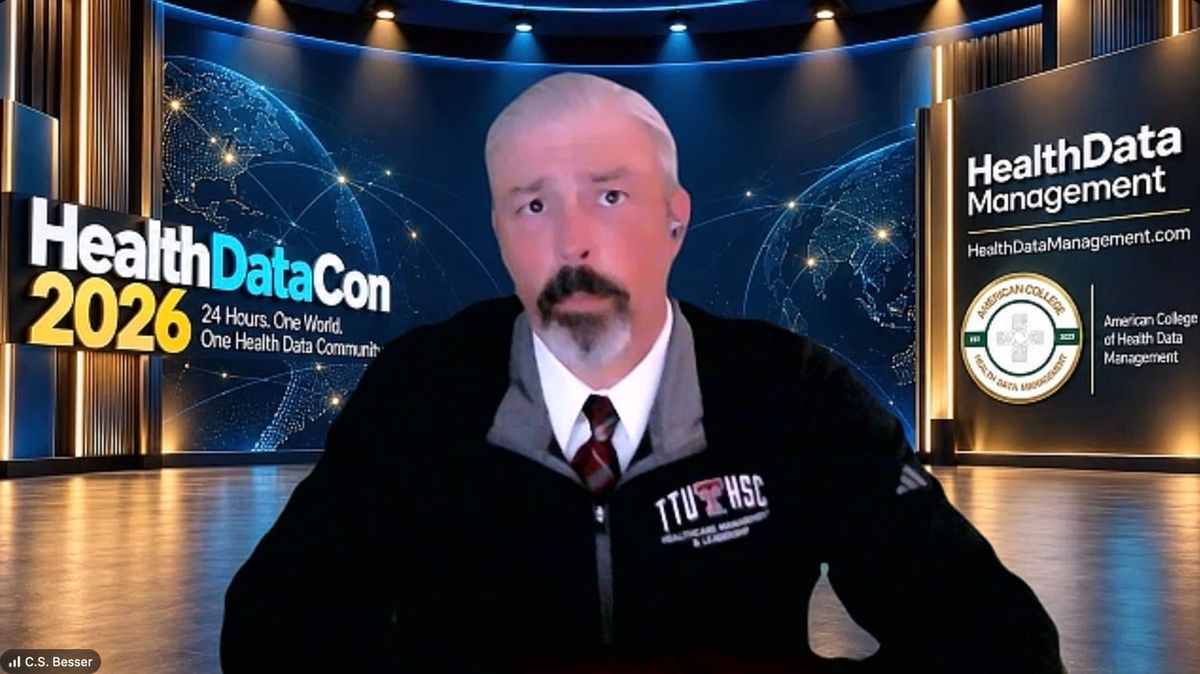
Christopher Besser urged health leaders to turn one broken data handoff into a measurable 90-day improvement plan during his October 15 presentation at HealthDataCon 2026. His developing Community Health Data Maturity Framework offers five capability levels and a 20-question assessment intended to help organizations decide what to fix next. He presented it as a formative tool, with implementation evidence still to come.
Besser, PhD, an assistant professor at Texas Tech University Health Sciences Center, spoke in the Americas program on moving community health data from fragmentation to actionable intelligence. His central test concerned whether information reaches someone able to use it. Collecting records, installing interfaces and producing dashboards are intermediate steps; the practical question is whether they support a better decision, referral or response.
Three kinds of fragmentation require different remedies
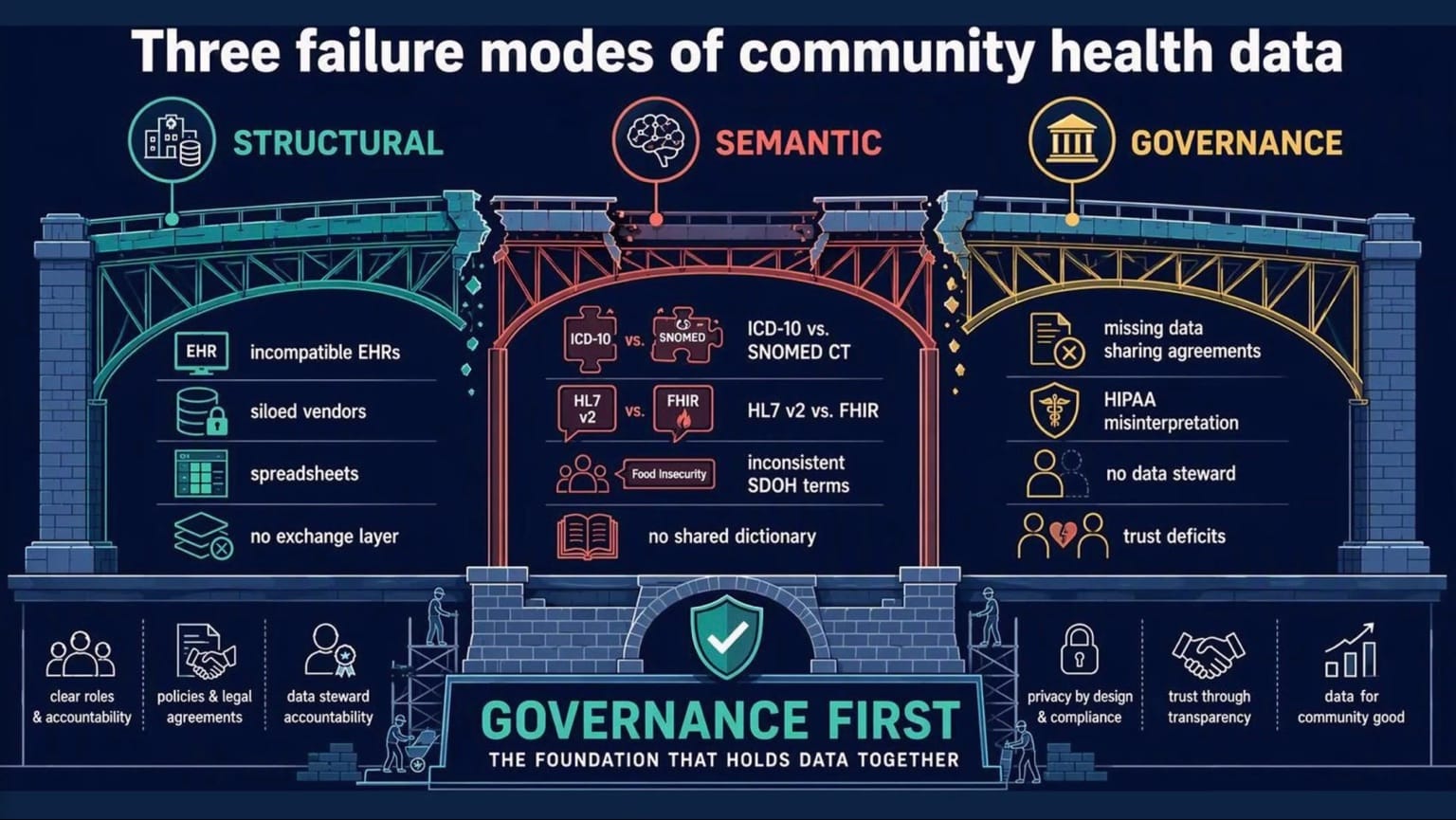
Besser separated fragmentation into structural, semantic and governance problems. Structural barriers prevent information from moving or records from being reliably connected across electronic health records, registries and community services. Semantic barriers arise when systems exchange information but attach different meanings to it, such as incompatible definitions or inconsistent recording of housing needs.
Governance concerns who may approve an exchange, who may use the information, for what purpose and under which safeguards. An interface cannot resolve the absence of an accountable decision-maker. Besser encouraged participants to identify one failing handoff and diagnose its actual obstacle, recognizing that poor coding, uncertain authority and technical limitations can reinforce one another.
His presentation materials referenced USCDI version 7 and HL7 FHIR R4. The federal USCDI announcement confirms version 7's July 2026 release, while FHIR R4 specifies a standard for healthcare data exchange. Besser's point was that standards provide a starting language; teams still need shared definitions, usable workflows and locally appropriate governance.
Five levels, supported by observable evidence
The framework begins with ad hoc practices, where information depends on individual spreadsheets, informal knowledge and reactive reporting. At the defined level, an organization can demonstrate a maintained data dictionary, recurring reporting and named stewardship. The integrated level connects relevant records so authorized users can examine clinical history, social needs and referral status together.
At the predictive level, connected information supports earlier identification of risk, with people responsible for interpreting alerts and monitoring responses. The transformative level adds a shared learning process: partner organizations contribute information, review outcomes and adjust services together. These are descriptions of operating capability, Besser emphasized, rather than a ladder defined by technology purchases.
“These levels describe capability rather than spending,” he said. A resource-constrained service may have strong partnerships and disciplined learning, while a better-funded organization still struggles to connect records. He urged teams to show evidence of routine practice and acknowledge that different domains can progress at different speeds.
For integration, the test is whether staff can follow an authorized patient journey across systems. For prediction, it includes who reviews an alert, what happens next and how errors or unequal effects are recognized. “The presence of an interface alone does not answer the question,” Besser said.
Illustrative cases, with explicit limits
Besser used three case archetypes to demonstrate how the framework might guide work. In a rural network with six clinics and four incompatible EHR systems, the sequence began with baseline assessment, governance and common definitions before technical integration and equity analysis. The teaching example described identifying 340 previously unrecognized high-risk patients; Besser cautioned that the transferable lesson was the shared population view, not an expectation that another organization would find the same number.
A second archetype involved a 14-site community health center consortium. Its illustrative figures showed screening completion moving from 23% to 71%, a 48-percentage-point increase, and time to intervention falling from 34 days to eight. Those measures described processes, not proof of improved health. “Clinical outcomes require their own definitions and evaluation,” he said.
The third case combined population signals and described an alert 19 days ahead of a comparison detection process. Besser explicitly said the case results should be treated as illustrative pending confirmation of their source and study design. During questions, he said he had no early implementation successes to offer for the developing approach, making clear that these numbers were not validated results of deploying his framework.
He also opened with a fictional patient, Maria, whose missing information represented a missed opportunity to respond. “We cannot assume that a data connection alone would have prevented that event,” he said. For predictive systems, he called attention to false alarms, missed events, delayed reporting and uneven coverage: “The decision pathway matters as much as the sophistication of the model.”
A scorecard for reflection, not ranking
The assessment contains four questions in each of five domains: data infrastructure, data governance, integration of social determinants of health, analytics capabilities, and impact and learning. Each item receives zero to five points, producing domain totals of 20 and an overall total of 100. Besser described a draft reflection exercise, not accreditation, certification or a validated benchmarking instrument.
In a question about weighting hospital versus payer data, Besser described his current construct as unweighted and at an early stage. His answer outlined development work still ahead, rather than supplying the specifications of a deployed predictive model. That distinction matters when assessing what the scorecard can currently establish.
“Score what happens routinely today,” he said. A successful pilot or unusually good day should not stand in for dependable performance. Keeping the five domain scores visible matters because similar overall totals may conceal different weaknesses; the priority is the gap constraining a real decision or handoff, rather than the highest possible score.
For social needs, Besser distinguished screening from completed assistance. “A connection between social needs screening and a clinical record creates an opportunity, not a completed intervention,” he said. Teams still need to learn whether a referral reached a community partner, whether support was available and what remained unresolved, while respecting consent, eligibility and patient preference.
That distinction also appears in the design of the Centers for Medicare & Medicaid Services' AHC model, which separately incorporated screening, referral, navigation and alignment with community services. That federal program provides context for the work involved in connecting people with support; it does not validate Besser's assessment or illustrative cases. A recorded need and a service delivered remain separate events to measure.
What the next 90 days should deliver
Besser divided the roadmap into three stages. During days one through 30, teams would review their assessment, select a priority problem, name an accountable steward and map relevant systems and owners. Days 31 through 60 would establish a limited foundation, such as a partner agreement, shared definitions for five essential data elements or a protected exchange answering one specific question.
During days 61 through 90, the team would demonstrate value through a population report stratified to examine equity, discuss its implications and set the next target. He urged participants to identify a responsible person, evidence of completion and an early review date. Scope mattered: the team should know which data are essential, which partner must participate and which decision the work will improve.
The World Health Organization's digital strategy likewise places organizational, human, financial and technological resources within the same planning task. Besser encouraged learning across countries while adapting to local law, culture, infrastructure and community priorities. In the discussion, he also emphasized bringing community voices and relevant expertise into the choice of the first problem to address.
Asked how to distinguish collecting data from using it, Besser returned to the original purpose: “Can you answer the question that you intended to set out to answer?” The challenge was to demonstrate a useful capability and learn from its results. His closing message put the intended beneficiary back at the center: “Your community deserves data as connected as the people who live there.”