Kenneth R. Deans Jr. Opens HealthDataCon 2026 With a Global Call to Learn
Opening HealthDataCon 2026, Kenneth R. Deans Jr. connected global learning, five shared pillars and human responsibility with a call to test ideas and bring evidence back to the community.

As one healthcare team begins its day, another hands over responsibility at the end of a shift. Patients still need answers, families still face decisions and health systems still depend on people making sense of information. Kenneth R. Deans Jr., who holds a Doctor of Health Administration degree, opened HealthDataCon 2026 with that shared reality and a question: Why should a global professional community organize its learning around a single region’s workday?
His October 15 opening welcome launched the inaugural 24-Hour Global Conference with a call to exchange experience across borders, test assumptions and carry useful ideas back into practice. Deans is president and CEO of Health Sciences South Carolina, the parent company of Health Data Management, and also serves as Health Data Management’s CEO and company board chair.
The session, Welcome to HealthDataCon: Why the Conversation Must Follow the Sun, connected the conference’s international format to a larger purpose: helping health data professionals learn from one another while remaining accountable for what their work changes.
Watch the full opening welcome: 21 minutes, 43 seconds. Video credit: HealthDataCon 2026.
A global conversation built around participation
Deans described a program moving through the Americas, Asia-Pacific, Europe, the Middle East and Africa. Its 24-hour model created space for regional perspectives within a continuous conversation. The format recognized that colleagues work across different languages, health systems and operating conditions, and should have opportunities to contribute while they are awake.
Participation did not require staying online for every hour. He encouraged attendees to choose relevant sessions while leaving room for unfamiliar perspectives. “Please consider making room for a perspective that you might not normally encounter in your routine day-to-day,” Deans said.
A colleague elsewhere may already have confronted a problem another organization is only beginning to recognize. Their solution may need adaptation, but the experience can reveal questions, mistakes and opportunities sooner. That is a practical argument for international learning: the useful exchange includes how an approach worked, where it struggled and which local conditions shaped the result.
He thanked speakers, Fellows, moderators, support staff and participants for making that exchange possible. The opening framed their contribution as more than attendance. The value would come from connecting what one professional knows with what another needs to understand.
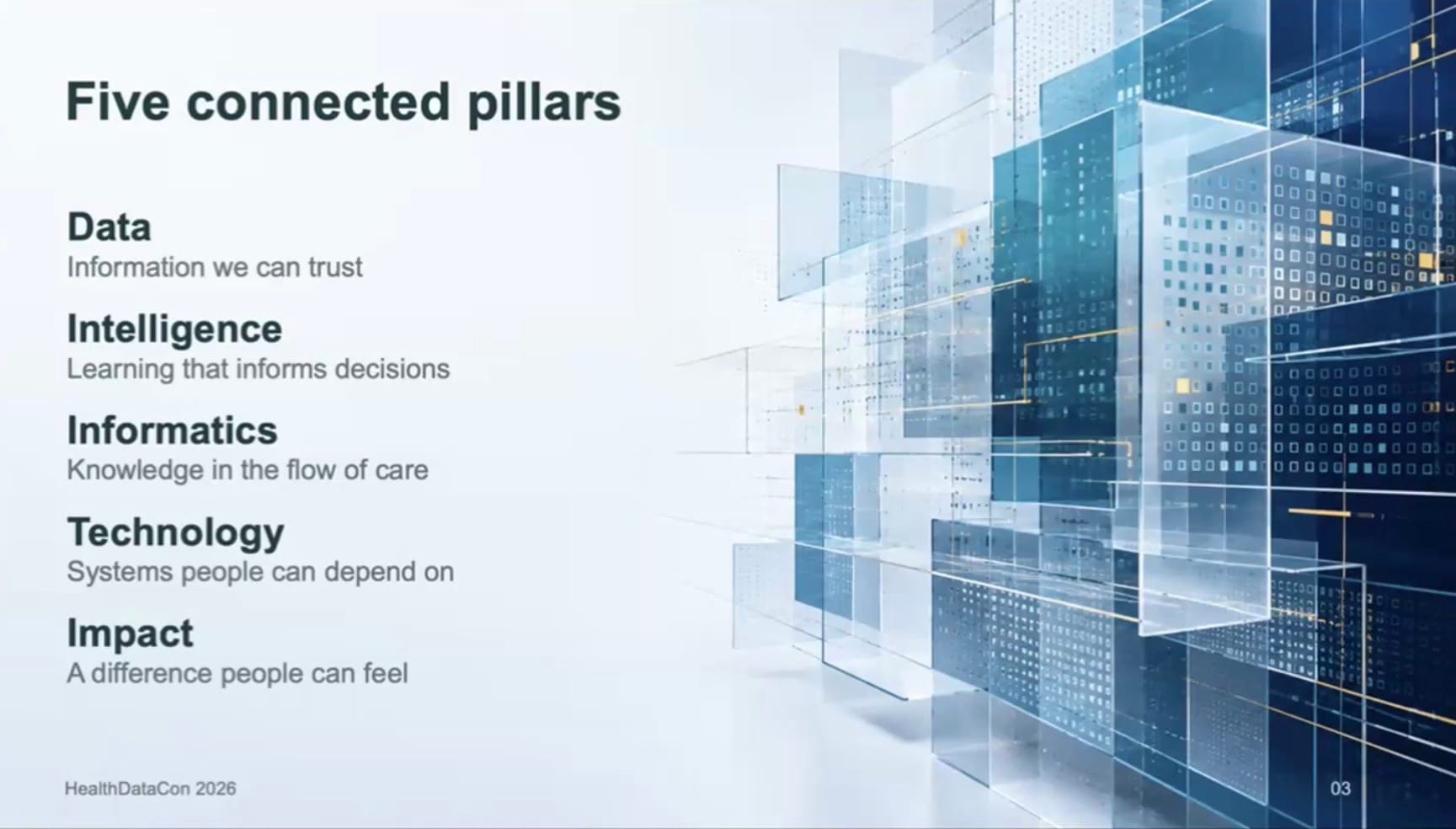
Five pillars connect information to consequences
The conference’s five pillars provided a common framework: data, intelligence, informatics, technology and impact. Deans explained them as connected responsibilities. Data asks whether information is dependable. Intelligence asks what can be learned from it. Informatics connects that learning to care delivery, while technology supplies the systems that support the work.
Impact tests the result against people’s health, experience and ability to do their jobs. “Those connections matter a lot more than just the labels,” he said. A presentation could address several pillars because a useful implementation rarely stops at producing a dataset, recommendation or technical capability.
He previewed Dr. Laura Gelfman’s palliative care session as an example. Information in a record could become a trigger, a work list and a clinical conversation that reaches someone whose needs might otherwise remain unseen. Asking which patients remain unreached makes the dashboard part of an ongoing clinical responsibility.
Other examples connected infrastructure with cybersecurity, workforce readiness and governance, or examined leadership under constraint and the validation of digital twins. Across maternity care, oncology, information exchange, coding and AI, he emphasized patient and family voices and nursing judgment. Technical sophistication can leave important needs overlooked unless those perspectives shape the discussion.
Keep professional judgment inside the AI conversation
Deans placed human responsibility at the center of health intelligence. AI is making answers easier to produce, but deciding whether an answer belongs in a particular clinical or operational decision still requires discernment. The relevant questions include who is represented in the data, what happens when the setting changes and who reviews or challenges a recommendation.
That emphasis is consistent with the broader purpose of NIST’s voluntary risk framework, which addresses trustworthiness across the design, development, use and evaluation of AI systems. In the opening remarks, however, Deans brought accountability back to the people closest to care and operations: the nurse using a workflow, the patient experiencing its consequences and the colleague keeping a service running during disruption.
He encouraged attendees to ask presenters what changed after implementation, what surprised them and what they would do differently. Another question was whether the conditions that enabled success would exist in the listener’s own organization.
“Thoughtful disagreement is welcome here,” he said. Respectful challenge can expose an assumption that agreement leaves unexamined. The multidisciplinary program was designed to make those encounters possible, bringing clinicians, researchers, engineers, cybersecurity professionals, operational leaders and patient advocates into discussions about shared problems.

Apply the learning discipline to the conference itself
The inaugural event was also a test of the organizers’ approach. Deans acknowledged that planning could not reveal everything the team would learn during delivery. Some elements would work well; others would require adjustment. Feedback would help determine what to keep, change or reconsider before future events.
He drew on Dr. Carol Dweck’s work on growth mindset, emphasizing development through effective strategies, feedback and support. He also cited Peter Sims’s Little Bets, which explores how small experiments and discoveries can inform larger advances. In his application of those ideas, effort matters alongside willingness to change direction when evidence warrants it.
“I would argue we also need to provide evidence-based management and evidence-based leadership,” Deans said. He explicitly connected experimentation in healthcare with the obligation to respect patient safety. Learning quickly does not remove the responsibility to define appropriate boundaries for a test.
“We’re testing a format for learning together,” he said. He asked participants to leave with one practical commitment: a conversation, a governance question or a carefully bounded test inspired by a session. Record what it is intended to teach, observe the result and bring the learning back. His ambition was for an idea encountered in 2026 to return in 2027 with additional evidence from another organization.
Build a community that continues after the event
The welcome also outlined plans across Health Data Management, the American College of Health Data Management and the conference series. Their shared platform connects reporting and professional experience with opportunities to learn and contribute. Deans described Fellowship as recognition of experience and qualifications coupled with ways to put that knowledge to work for others.
He announced planned additions including a Fellows and sponsors engagement portal, an expanded done-with-you publishing program and a corporate Fellow partner program. He also described an intended AI-powered engine for Health Data Management, aimed at improving speed, usability and engagement. Potential capabilities included listening options, apps and automobile audio integration, with HealthDataCon eventually housed within the broader platform.
A proposed Fellow Plus AI credential would recognize colleagues demonstrating meaningful AI use, education and relevant learning in healthcare. Deans presented these initiatives as forthcoming work, with requirements and details to follow. He also outlined a 2027 conference schedule targeting January, June and September, noting that June was still being firmed up, and said in-person events were under consideration as the community developed.
After practical guidance on navigating the virtual lobby and participating in questions, he directed attendees to the opening keynote by Patrick Newbold, Director and Chief Information Officer of the Office of Information Technology at CMS. The welcome left a clear assignment for the community: encounter another perspective, examine what makes it useful and return with evidence of what happened when it was put to work.