Dr. Hudson Garrett Jr. Makes Outcomes the Test of Healthcare Value
At HealthDataCon 2026, Dr. Hudson Garrett Jr. urged healthcare leaders to connect product decisions to patient outcomes, staff workload and total cost through clear measurement plans and accountable reviews.

A cheaper catheter can become a more expensive decision. In an illustrative scenario presented at HealthDataCon 2026, a projected $310,000 purchasing savings unraveled when the evaluation expanded to include repeat insertions, wasted supplies, nursing time, specialist support and patient complaints.
For Dr. Hudson Garrett Jr., the lesson was about what healthcare organizations choose to count. A lower invoice does not establish that a product improved care or reduced the total resources required to deliver it.
The executive director and executive vice president of the Association of Healthcare Value Analysis Professionals, or AHVAP, presented “Building the Case for Outcomes-Driven Healthcare Value Analysis.” He urged clinical, financial, operational and data leaders to agree on success before approving a purchase, then return to the evidence after implementation.
“Unit price is important, but it is definitely not the only thing that we should be considering,” Dr. Garrett said.
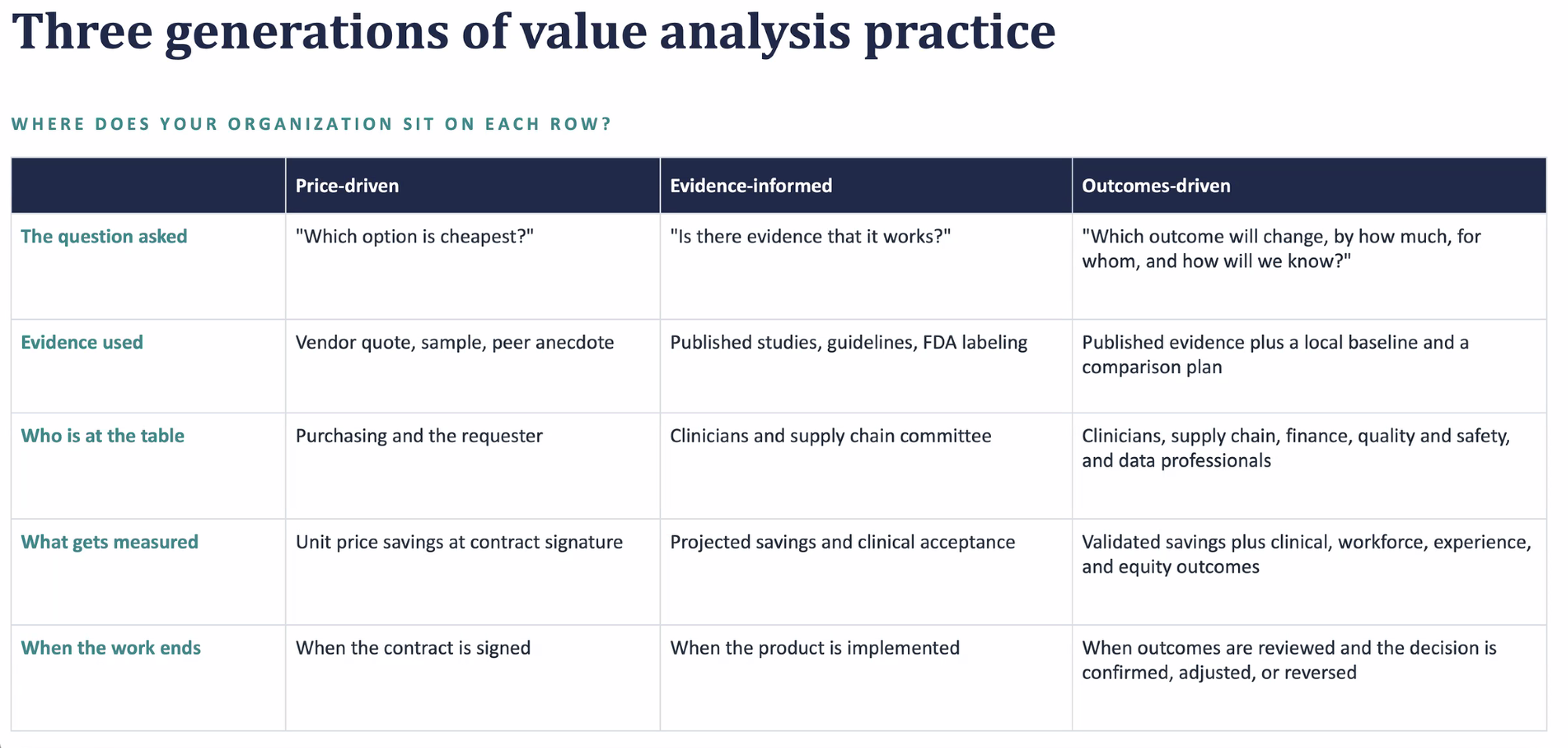
Make the outcome part of the purchasing decision
Dr. Garrett described value analysis as a discipline for selecting, implementing and evaluating products, services and technologies against measurable outcomes. Its scope includes patients, the workforce, operations and finances. Innovation belongs in that process, with a clear account of what it is expected to improve.
His presentation traced three approaches: choosing the cheapest option, considering evidence that an option works, and specifying which outcome should change locally. The last approach adds a baseline, comparison plan, accountable owner and follow-up review. The work continues beyond contract signature and product rollout.
The financial pressure is substantial. The American Hospital Association’s 2026 cost report estimates that labor represented about 60% of hospital expenses in 2025 and supplies about 18%. That distribution helps explain why a product’s effect on staff time can matter alongside its purchase price.
Dr. Garrett organized the problem around people, processes and products, in that order. Staff need role-specific competence, processes need to be reliable, and products need to fit the care being delivered. Changing a supply without examining that surrounding work can move costs elsewhere.
Payment policy also extends accountability beyond the purchase. CMS’s TEAM model holds participating hospitals accountable for cost and quality across selected surgical episodes, ending 30 days after discharge. It covers five procedure categories, including joint replacement, spinal fusion and coronary artery bypass graft surgery. Such models make downstream complications and transitions relevant to decisions made much earlier.
Appraise the evidence before adopting the product
Dr. Garrett proposed four questions for evaluating studies supplied by vendors: What was the comparator? Which outcome was measured? Who funded, designed and analyzed the research? Does the study population resemble the patients who would receive the product?
Industry funding does not automatically invalidate research. The committee still needs to understand the sponsor’s involvement and whether the study supports the particular claim being made. A favorable result against one comparator may not answer the hospital’s question about its existing standard of care.
The same discipline applies to setting. Evidence from an intensive care unit cannot simply be assumed to establish the same benefit on a general ward. Dr. Garrett discussed artificial intelligence as an aid to finding and assessing literature, while keeping the evaluation focused on study design, meaningful outcomes and population fit.
He illustrated the approach with chlorhexidine bathing. A 2013 randomized trial enrolled 7,727 patients across nine intensive care and bone marrow transplantation units in six hospitals. Compared with nonantimicrobial washcloths, chlorhexidine washcloths were associated with 23% lower acquisition of multidrug-resistant organisms and 28% lower hospital-acquired bloodstream infection rates.
Those findings support a defined intervention in the studied settings. Applying them elsewhere still requires attention to local patients, implementation, adverse reactions, staff time and utilization. A published effect provides a reason to evaluate a change; the local measurement plan establishes whether the intended benefit follows.
Connect the product, patient and outcome
For data professionals, Dr. Garrett identified a practical starting point: connect product records to the encounter in which the product was used. Item masters, charge capture, implant logs and device identifiers can help establish which patients received which intervention.
That connection is necessary for comparing results fairly. Teams also need to identify relevant patient risks, exposure time and concurrent changes in care. When several elements of an infection-prevention bundle change together, an improved outcome cannot automatically be attributed to one product.
“We need to know where we’re starting with and where we’re trying to go,” he said.
Denominators are part of that foundation. CDC’s NHSN protocol, for example, calculates central line-associated bloodstream infection rates using infections per 1,000 central line days. Counting infections alone leaves out changes in exposure and can distort comparisons.
Dr. Garrett favored reviewing a full year of baseline data when feasible, while acknowledging that organizations may need other sources when local history is unavailable. A useful measure library would standardize definitions, denominators, sources and update schedules so each committee does not have to rebuild the measurement process.
He also emphasized monitoring during implementation. Longer follow-up may be needed to assess outcomes credibly, but emerging safety problems should prompt action as they appear. Scheduled reviews and early warning signals serve different, complementary purposes.
Give the committee permission to change course
“We don’t need to be afraid to stop something,” Dr. Garrett said.
His proposed measurement plan defines the primary outcome, baseline, denominator, comparator, review dates, stop rule and owner before approval. That makes a reversal an anticipated governance decision when evidence warrants it.
In another illustrative case, a premium antimicrobial central line dressing added nearly $200,000 in cost. After two quarters and more than 20,000 central line days, the expected infection-rate improvement had not appeared. The committee redirected resources toward established care practices and specialized nursing support.
The scenario demonstrates a decision process; it is not proof that an entire product category lacks value. A local evaluation must consider uncertainty, implementation fidelity and competing explanations before drawing broader conclusions. Its immediate purpose is to determine whether the organization’s own investment is delivering the intended result.
Dr. Garrett’s catheter example made the same point from the opposite direction. Once repeat procedures, waste and clinical workload were included, the apparently cheaper option had a higher total cost. Acquisition savings had concealed costs incurred by staff and patients.
The Institute for Healthcare Improvement’s Quintuple Aim provides a broader frame: population health, experience of care, per-capita cost, workforce well-being and health equity. Dr. Garrett connected those dimensions to practical questions about staff workload, access and the availability of products for specialized populations.
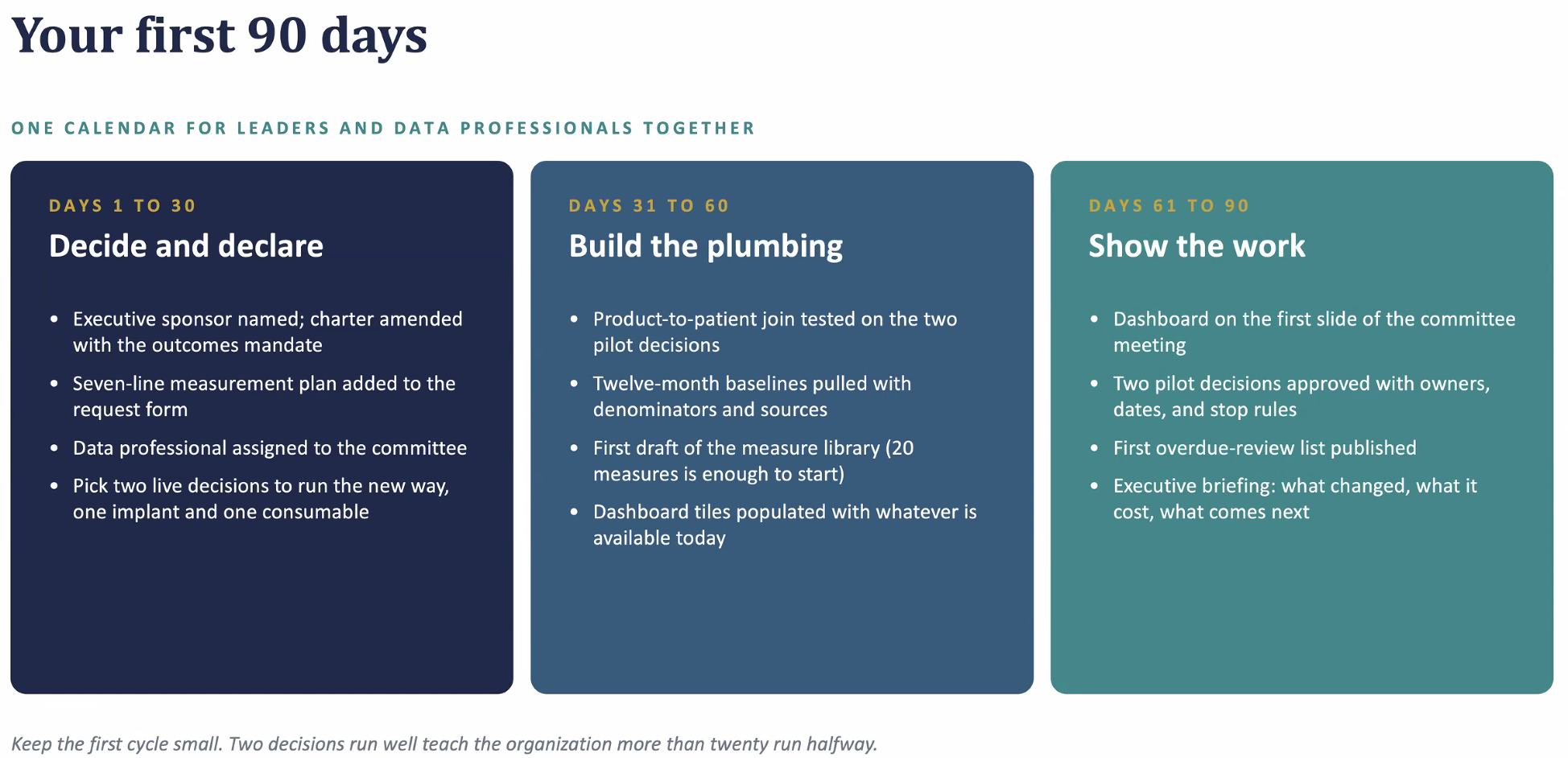
Start with two decisions and a visible review cycle
Dr. Garrett’s 90-day approach begins with an executive sponsor, a written charter, a data professional assigned to the committee and two pilot decisions. The next phase builds the product-to-patient connection, assembles baselines and populates a dashboard. The final phase puts decisions, owners, review dates and stop rules in front of leadership.
“Someone has to be responsible for it,” he said.
He proposed a committee dashboard covering decisions, measurement plans, completed reviews, validated savings, outcome signals and unresolved safety issues. Its purpose is to show what requires attention and who must act. Executive sponsors can then remove barriers without taking over every operational detail.
AHVAP’s public position statements offer supporting resources on value analysis practice, professional competencies, standardized product review and responsible AI use. Dr. Garrett encouraged multidisciplinary participation and sharing unsuccessful efforts alongside successful ones.
“People want to be a part of a winning strategy,” he said. For a value analysis program, demonstrating that progress requires following the decision into practice: identifying what changed for patients and staff, what it actually cost, and whether the evidence supports continuing it.