New HIPAA rule gives patients a faster route to records through health apps
Amy Gleason explained how the final privacy rule could make it easier to request records from multiple providers, and why outdated logins still stand in patients’ way.

Federal privacy rules will give patients a shorter wait for copies of their medical records and clarify when they can get electronic records in a health app they choose. Amy Gleason, a deputy administrator and chief product officer at the Centers for Medicare & Medicaid Services, explained what that change could mean in a Nov. 16 conversation with Zus Health co-founder and CEO Jonathan Bush on the Main Stage in Las Vegas. She used a problem familiar to anyone trying to assemble a record across providers. Connecting an app is of limited use when patients still have to find and maintain a separate login at every institution.
Gleason said her daughter, who has a rare disease, had 12 doctors across six health systems, four pharmacies and 51 patient portals. Even when an app can request records, she said, forgotten passwords, outdated verification details and accounts that providers have deactivated can still break the process. An earlier business Gleason helped build used nurses and technology to collect and organize records for families. Bush, who led the discussion, used that experience to frame his questions about which changes are mandatory and which depend on companies choosing to participate.
A request from the patient, through an app
The Department of Health and Human Services announced the final HIPAA Privacy Rule revisions that day. The rule clarifies when a person can obtain a copy of their electronic protected health information through a personal health app, including when a covered entity can produce it in the requested form and format. Gleason described the app request as “a right of access to a copy of her information.” That distinction matters because the patient is exercising an existing right through a different route. The workflow should be different from one in which an unrelated party is asking a provider to release the patient’s information.
Providers still have to establish who is making the request. Gleason pointed to federal digital identity standards as examples of how organizations can verify a person’s identity and confirm that the person is securely signing in. She described transmitting proof of identity with the request through a health information network or an application programming interface. For a family collecting records from multiple organizations, the practical question is whether the organizations can accept the identity evidence provided with the request. Sending it electronically will do little for the patient if each provider still redirects them to an old portal account.
The HHS fact sheet says covered entities will generally have to respond as soon as practicable and within 15 calendar days, down from 30, with one permissible extension of up to 30 days. The rule also specifies which electronic copies must be provided without a charge. When electronic delivery can happen more quickly, Gleason said, she expects it to be “almost instantaneous with electronic data.” HHS sets the effective date at 60 days after publication and the general compliance deadline 180 days after that effective date. The date the rule was announced and the date organizations must comply are different milestones.

Asked how much access could improve, Gleason said CMS had been tracking that about 60% of patients could obtain some data through an app. She described the agency as tracking toward 80% or 90% with the change. She also cautioned that a response may be incomplete. The remarks gave no methodology or time series for those figures. The distinction between receiving some information and receiving a usable record matters most for patients whose care crosses many organizations, since a single missing result can still leave them calling a clinic or carrying papers to a visit.
Health plans face a separate set of deadlines
Bush asked Gleason to identify what organizations actually have to do. She began with certified electronic health records and interfaces that are working in practice. She then described payer requirements covering a provider’s access to health plan data, a patient’s ability to authorize information sharing between their old and new insurer, and electronic exchange for prior authorization. CMS’s separate interoperability and prior authorization rule generally sets the applicable interface deadlines for Jan. 1, 2027. Which requirements apply depends on the payer and the type of data exchange.
Those are distinct tasks even when they depend on the same underlying infrastructure. A patient switching insurers needs continuity when their covered care or treatments carry into the new plan. A provider seeking a prior authorization needs the information required to submit a request and a way to receive the payer’s decision. Families asking for their own records need a route that works across the organizations holding them. Treating these as separate workflows helps explain why launching one interface does not remove each barrier Gleason described.
Where CMS is asking companies to participate
“We still use fax machines. We have people drive CDs across town,” Gleason said as she turned to the voluntary CMS Health Tech Ecosystem. She described working groups on online appointment booking, real-time benefit information and matching patients with clinical trials. Each effort depends on data an organization can share and someone else can use. A patient can see a clinician listed in a directory, for example, and still have to call if the tool cannot tell whether a visit is available to book. Better records access and better scheduling address separate moments in the same patient’s experience.
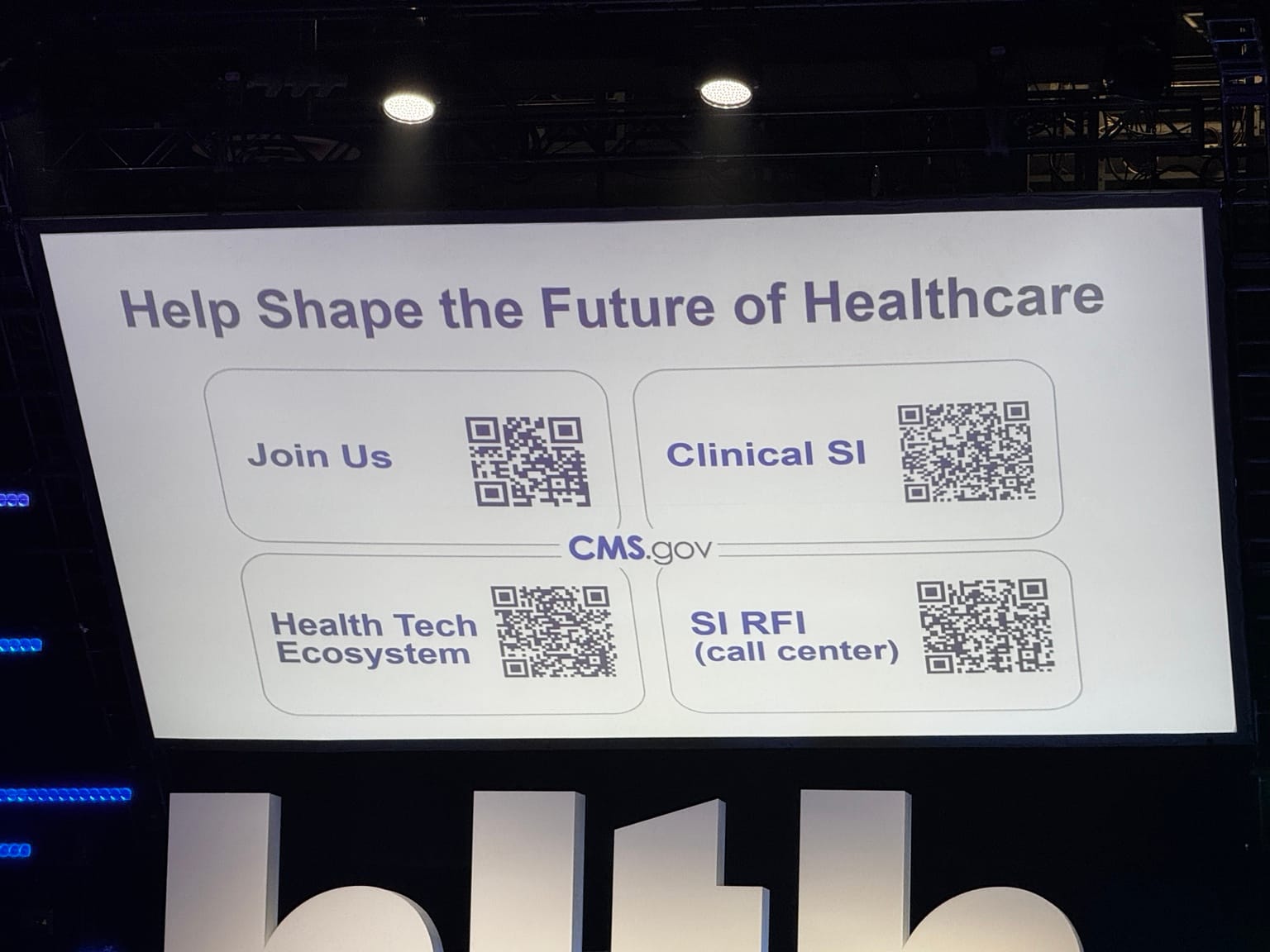
Gleason said CMS created its product office to look across Medicare, Medicaid and the Marketplace for needs that individual projects may have in common. Her question was “how can we solve it across the system and reuse instead of always rebuilding?” She also linked electronic access to clinical AI. In her account, more complete data could make the tools more useful, while monitoring would help show whether tools perform safely and improve care. She described outcomes and access, alongside safety and cost, as measures of progress.
The first change patients can look for is whether obtaining a usable copy of their records becomes easier. A successful request may still reveal gaps in what an app receives across clinicians, pharmacies and insurers. By describing both the access rule and the work on scheduling and benefits, Gleason spelled out why even a faster response to a records request is only one part of the change. The practical gains depend on what a patient can do with the information once it arrives.