NHS AI Scribe Errors Expose Gaps in Patient Safety
Patient-reported errors in NHS AI-generated notes are testing whether rapid adoption can deliver administrative gains without compromising record accuracy, consent, accountability and trust across England.
Twenty-seven ambient voice technology suppliers are now listed on NHS England’s national registry, but a new warning shows how an automated note can become a clinical liability when nobody catches an error. Healthwatch England says patients found incorrect drug names, a false diagnosis and missing treatment instructions after clinicians missed the mistakes. The cases do not establish an overall error rate, but they expose a weakness in scaling the tools while relying on local organizations and professionals to assure their outputs.
The most serious account involved a patient whose AI-written summary said an MRI showed demyelination, a form of nerve damage associated with disorders including multiple sclerosis, when the intended phrase was “null demyelination.” According to the new warning, the record was corrected only after the patient, herself an NHS professional, challenged it. Other patients identified a prescribed medicine replaced by a similarly named drug and a clinic letter that omitted an instruction to seek a repeat migraine prescription from a general practitioner.
Those reports are anecdotes gathered through a self-selecting channel, not a controlled comparison of human and machine documentation. Conventional notes also contain mistakes, and research does not yet show whether AI scribes produce more or fewer consequential errors overall. But the incidents are consistent with a broader Healthwatch survey of 4,039 adults, in which 69% said a clear commitment by clinicians to check AI output would make them more comfortable with its use.
How an Ambient Scribe Becomes a Medical Record
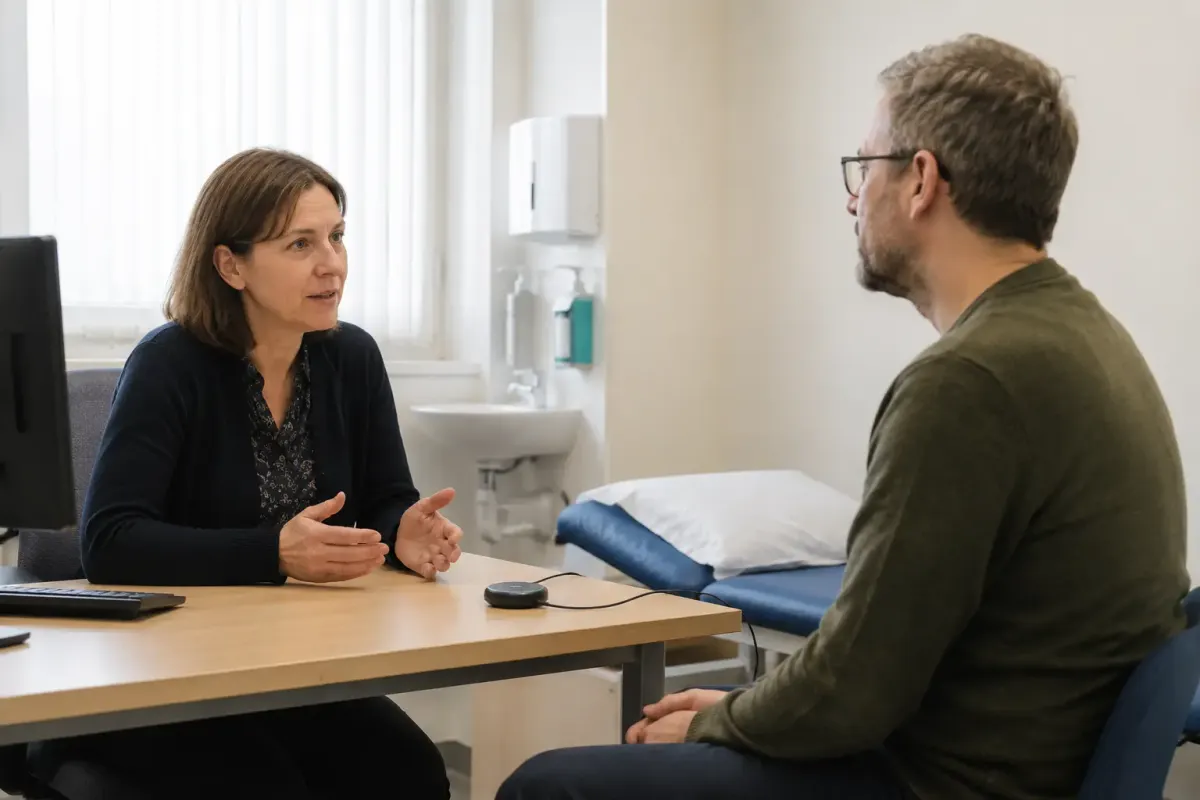
Ambient scribes combine several operations that can fail in different ways. A microphone captures a consultation, speech-recognition software converts the audio into a transcript, and a generative model turns that transcript into a structured note, letter or task. The clinician is then expected to review and edit the draft before saving it to the electronic health record. An acoustic mistake can therefore change a word before summarization begins, while the language model can omit, compress or invent information even when the transcript is accurate.
NHS guidance treats final human review as a central safety control. Yet checking a long draft against a fast, nuanced conversation requires attention, memory and time, the same scarce resources the system is supposed to preserve. A clinician who assumes the draft is usually right may miss a plausible but wrong medication, negation or follow-up instruction.
The national registry does not remove that operational burden. NHS England says suppliers provide evidence that they meet entry criteria, but it also states that all assurance and purchasing decisions remain with the local NHS organization. The list supports procurement; it is not a comparative performance table, a guarantee that every product works equally well in every specialty, or evidence that a system has been tested across accents, languages, disabilities and complex multi-speaker encounters.
Why the NHS Is Scaling the Technology
The adoption case is grounded in a genuine problem. Doctors and nurses spend substantial time documenting care, often after appointments or shifts, and administrative work contributes to cognitive overload. A London evaluation led by Great Ormond Street Hospital examined more than 17,000 patient encounters across nine NHS sites and reported that clinicians using one scribe system spent nearly a quarter more time interacting with patients. The hospital study included hospitals, general practices, mental-health services and ambulance teams, giving it broader operational relevance than a single-clinic pilot.
NHS England has moved from experimentation toward scale. Its July rollout plan said four southwest London trusts would extend the technology to tens of thousands of staff, while two other trusts were expanding programs to more than 3,000 clinicians. A St George’s emergency-department pilot reportedly saved 47 minutes per clinician per shift, enough for one additional patient encounter.
Time saved is an operational outcome, however, not proof of safer care or better health. The Nuffield Trust found documentation savings to be the most consistent result in the literature but said much less is known about what happens next: whether the minutes improve continuity, staff wellbeing, capacity or patient outcomes, or are simply absorbed by an overloaded service. That distinction is crucial when economic models convert minutes into hypothetical appointments or national savings.
Accuracy Depends on Context, Not One Score
Published evaluations offer reasons for both confidence and caution. One 2026 quality study found that 337 of 356 AI-generated clinical notes, or 94.7%, were free of significant errors. That is encouraging, but it also means a small minority contained defects judged important, and aggregate performance can hide whether errors cluster in particular specialties, patient groups or encounter types. A system that is highly accurate on routine follow-ups may still be unsafe when medication lists are long or clinical language is ambiguous.
The danger is not limited to hallucination. In simulated English-Spanish consultations, researchers found that ambient scribes propagated mistakes made during interpretation into downstream notes. The interpreter study did not measure live patient harm, but it demonstrates how an error introduced early in the information chain can acquire the authority of a polished clinical document. Similar vulnerabilities can arise from overlapping voices, unfamiliar accents, poor audio, communication disabilities or a consultation involving a caregiver.
Clinicians themselves report a mixed picture. A survey of 1,003 UK general practitioners found that 14% were already using ambient AI scribes and another 39% intended to adopt them; among users, 80% reported less documentation time and 55% rated the generated notes better than their usual records. The GP survey was an exploratory, self-reported snapshot rather than an audit of clinical accuracy, so it measures perceived utility and quality, not comparative rates of harm.
Regulation Turns on What the Product Claims to Do
The regulatory boundary is shaped by intended purpose. July guidance from the Medicines and Healthcare products Regulatory Agency says some ambient voice products qualify as medical devices and must meet medical-device requirements, while others do not. A product that merely records, transcribes or performs administrative summarization may fall outside device rules; functions that provide information for diagnosis or treatment can cross the threshold depending on how the manufacturer defines and markets them. The MHRA guidance also makes clear that safe deployment of non-device products sits outside its scope.
That division creates a governance problem because administrative text can still influence clinical decisions. A wrong drug name may affect a later prescriber even if the software never recommended treatment, while an omitted instruction can interrupt follow-up. Risk depends on where output travels, how much clinicians trust it and whether patients can correct the record.
The answer is not necessarily to classify every transcription product as a medical device. Overbroad regulation could raise costs and slow useful tools without eliminating the need for local testing and professional review. But the current structure leaves responsibility distributed among vendors, procurement teams, information-governance officers, clinicians, professional regulators and patients. Healthwatch’s cases show why that distribution needs an explicit correction pathway rather than an assumption that one of those parties will notice.
Safety Must Be Measured After Deployment
The immediate safeguard is disciplined review before any AI-generated text enters the record, with extra scrutiny for medicines, allergies, diagnoses, negations and follow-up actions. Health systems can support that work through structured highlighting, side-by-side access to the transcript where lawful, and audits that compare saved notes with source conversations. They also need simple patient-facing procedures for reporting errors, documented ownership for corrections and an audit trail showing what the model produced and what the clinician changed.
Performance monitoring should be stratified rather than reduced to one accuracy percentage. Trusts need to know whether failures differ by specialty, accent, language, disability, consultation length, background noise and number of speakers. Patients should be told at the start when ambient recording is being used and given a workable way to decline it, especially for sensitive discussions. In Healthwatch’s polling, 81% wanted professionals to disclose use and seek consent, while comfort fell from 48% for routine checks to 23% for conversations about domestic abuse.
The latest warning does not overturn evidence that ambient scribes can reduce documentation work. It does show that productivity and safety cannot be assessed on separate tracks: every saved minute depends on a verification process capable of catching the error the machine introduced. The next test for the NHS is therefore not how many clinicians receive a scribe, but whether national and local systems can measure consequential errors, correct records quickly and preserve patient trust as adoption expands.