Singapore Funds Spatial Biology Platform With S$6 Million
Singapore’s S$6 million SPADE platform links hospitals, pathologists, data scientists and a sequencing vendor to turn spatial tissue maps into diagnostic leads—while validation, reproducibility and clinical utility remain the decisive tests.

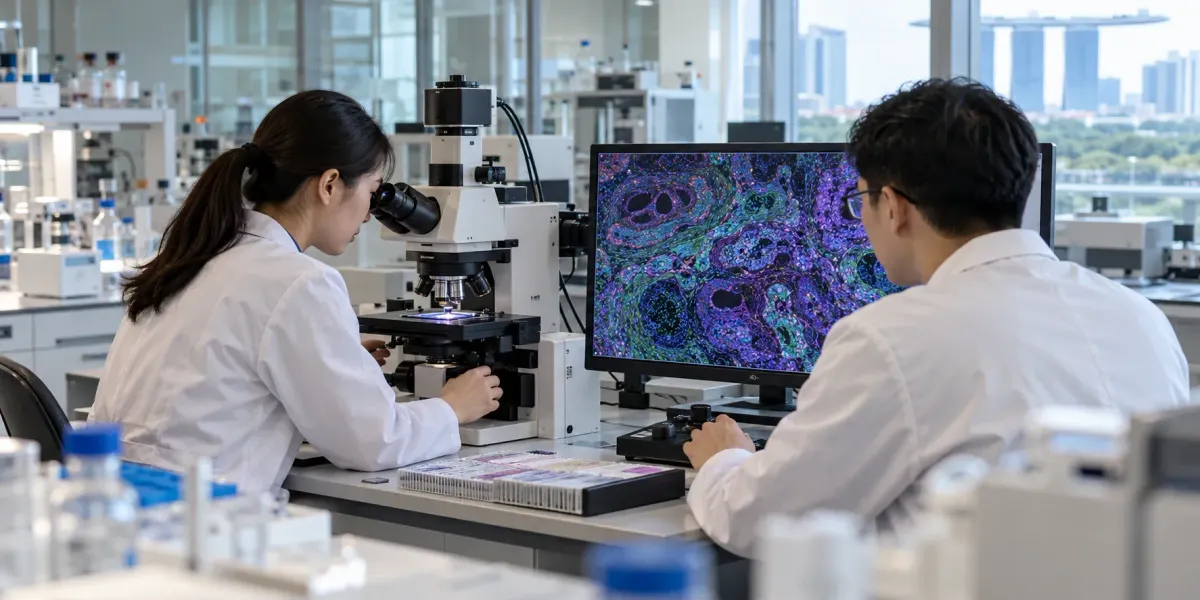
A S$6 million grant is funding a new Singapore platform that will combine spatial tissue profiling, pathology, data science and artificial intelligence across the SingHealth Duke-NUS Academic Medical Centre. Launched on September 25, the SPADE platform is meant to move molecular maps of human tissue toward diagnostic tests and treatment research, but its announced goals remain prospective rather than evidence of a new clinical service.
SPADE—Spatial Profiling and Disease Exploration—is led by the National Cancer Centre Singapore, with Singapore General Hospital and Duke-NUS Medical School as co-leads. Its structure matters as much as its equipment. The platform is designed to connect clinicians who define patient questions, pathologists who control tissue quality, laboratory teams that generate molecular measurements, and computational scientists who interpret unusually large datasets. An independent industry report also identified the S$6 million commitment and cross-institutional model as the core of the launch.
Why spatial information changes the question
Conventional bulk sequencing can reveal which genes are active in a tissue sample, but it averages signals across many cells. Single-cell methods separate those cells and identify rare populations, yet dissociation can erase information about where each cell sat and which neighbors surrounded it. Spatial methods preserve that geography. They can measure RNA or proteins while retaining a map of the tissue, allowing researchers to ask not only what is present but where it is present and what cellular interactions are occurring nearby.
That distinction is especially important in cancer. Two tumors with the same diagnosis may contain different immune niches, stromal structures and invasive fronts. A molecular signal concentrated at the tumor boundary may have a different implication from the same signal dispersed throughout healthy tissue. A recent clinical review describes spatial omics as moving from atlas-building toward diagnosis, prognosis and therapy selection, while emphasizing that scalable assays, standardized workflows, rigorous validation and regulatory-ready integration are still required.
Singapore already has much of the technical base needed for that work. Duke-NUS’s genomics facility supports next-generation and single-cell sequencing and operates a digital spatial profiler capable of measuring more than 18,000 protein-coding genes in selected tissue regions. A*STAR researchers have also built spatial-analysis tools and cancer programs that combine transcriptomics, proteomics, imaging and AI, according to an agency review. SPADE’s contribution is to organize such capabilities around shared clinical questions and translational workflows.
A platform built across institutional boundaries
The grant comes from the SingHealth Joint Office of Academic Medicine. SingHealth says the platform will use shared equipment, high-performance computing and AI analytics to identify targets for laboratory-developed diagnostic tests. It also envisions running multiple analyses on one tissue sample, potentially reducing repeat biopsies, and eventually creating a spatial tissue atlas that could train predictive models. Those are useful research objectives, but none is yet a validated patient benefit.
The first announced industry collaboration is a research agreement between the National Cancer Centre Singapore and 10x Genomics. The company will provide spatial-profiling technology and technical support. That arrangement may accelerate workflow development and access to evolving instruments, but it also makes transparent method reporting important. Platform choice affects tissue preparation, resolution, measurable targets, computational pipelines and cost; results generated on one system are not automatically interchangeable with those from another.
SPADE’s design attempts to address a common translation gap: advanced molecular studies often end with a publication because the discovery laboratory, clinical service, pathology workflow and product-development pathway are disconnected. Here, disease experts and hospital pathologists are intended to work alongside biomedical and computational teams from the start. That could make it easier to define the intended clinical use, select representative specimens and build validation into development rather than add it after a model has been trained.
Singapore has promising precedents, not final proof
The strongest local example is the Tumour Immune Microenvironment Spatial, or TIMES, score for hepatocellular carcinoma recurrence. In a Nature study, investigators combined the spatial patterns of five biomarkers and validated the model in 231 patients from five hospital cohorts. The reported real-world accuracy was 82.2%, with specificity of 85.7%. That result shows how location-aware molecular information can add prognostic signal, but it does not mean the score is ready for routine care. Prospective evaluation, calibration in additional populations and evidence that its use changes decisions or outcomes would still matter.
A second program, the Precision Medicine in Liver Cancer across an Asia-Pacific Network, used multiregion whole-genome and RNA sequencing to study distinct routes of recurrence after surgery. The peer-reviewed PLANet study analyzed genomic material from 106 patients and followed a broader prospective surgical cohort. Its authors reported biologically different recurrence patterns and built a machine-learning tool combining genomic and clinical information. Researchers are now applying spatial sequencing to the tumor microenvironment, showing how SPADE could connect an established cohort with a new analytic layer.
These projects provide scientific rationale and local operating experience. They do not validate every disease area, assay or AI model that SPADE may pursue. Cancer tissue is also only one potential application. Rare-disease characterization, inflammatory disorders and other conditions may require different sampling strategies, endpoints and reference standards. The platform’s value will therefore be demonstrated project by project rather than by the launch itself.
Reproducibility is the central technical test
Spatial datasets are unusually sensitive to pre-analytic variation. Time to fixation, tissue thickness, preservation method, staining, scanner settings and the selection of tissue regions can all change the measured signal. Computational choices then add another layer: cell segmentation, background correction, normalization, batch correction and cell-type labeling may each alter the apparent map. If case samples and controls are processed in different batches, a technical difference can be mistaken for biology.
A broad batch-effects review warns that technical variation can produce misleading findings or obscure genuine discoveries in large omics studies. Imaging-based spatial transcriptomics has prompted similar concern. A multicenter benchmarking study developed standardized metrics because cross-site and cross-platform reproducibility cannot be assumed. For SPADE, robust common controls, prespecified quality thresholds, external validation and transparent software versions will be as important as higher resolution or larger gene panels.
Data governance is another operational issue. Spatial maps can be linked to pathology images, genomic profiles and clinical histories, creating data that are both scientifically rich and potentially identifying. The launch announcement does not detail consent models, retention policies, access controls or rules for industry use. Those arrangements may exist within institutional protocols, but they will need to be explicit for each study and for any shared tissue atlas used to train AI systems.
What evidence should come next
The most informative early measures will be concrete: how many projects enter the platform, whether protocols work across participating laboratories, how diverse the patient cohorts are, and whether findings survive validation on independent specimens and equipment. For proposed diagnostics, investigators will need to establish analytical validity, clinical validity and clinical utility. A biomarker can be measurable and associated with an outcome yet still fail to improve care when added to existing pathology, imaging or clinical scores.
Health systems should also watch turnaround time, tissue consumption and cost. Running several assays on one sample could conserve scarce material, but complex spatial workflows may require specialized instruments, intensive computing and expert review. A faster or more detailed map is useful only if it can be delivered reliably at a point in the care pathway where clinicians can act on it.
SPADE is therefore best understood as infrastructure for disciplined translation. Singapore is investing in the people, specimens, machines and computational capacity needed to test whether spatial context can become a dependable clinical signal. The S$6 million commitment and 10x Genomics partnership make that effort more consequential, not conclusive. Its success will be measured by reproducible evidence and better decisions—not by the visual sophistication of molecular maps.