Chris Jones Calls for Patient and Family Voice in Health Data
At HealthDataCon 2026, Chris Jones drew on his family’s experiences to show how patient priorities, caregiver observations and a reliable response process can become part of everyday healthcare decisions.

Chris Jones asked health data leaders to begin with a small, consequential change: capture one patient priority before an encounter, make it visible to the care team and confirm that someone addressed it. The proposal gave a practical starting point to his HealthDataCon 2026 presentation about information that often remains outside the medical record: what patients and families know, observe and need.
Jones, founder and CEO of MatchRite Care and an executive fellow of the American College of Health Data Management, delivered “The Missing Data Layer: Designing Patient and Family Voice Into Health Data Systems” on October 15. His argument drew on his mother’s cancer treatment, his son CJ’s illness and his family’s ongoing work supporting his son Aidan.
Across those experiences, technology improved. The family’s responsibility for connecting information remained. For Jones, the next stage of health data design must give patients and caregivers a reliable way to contribute knowledge and see what happens because they shared it.

From a folder of records to a missed opportunity
Jones recalled his mother, a registered nurse raising seven children, seeking treatment for ovarian cancer before her death in 1991. She carried a folder containing handwritten medical records, her own notes and Scriptures. As she traveled for care, that folder helped connect clinicians who otherwise lacked a common view of her treatment.
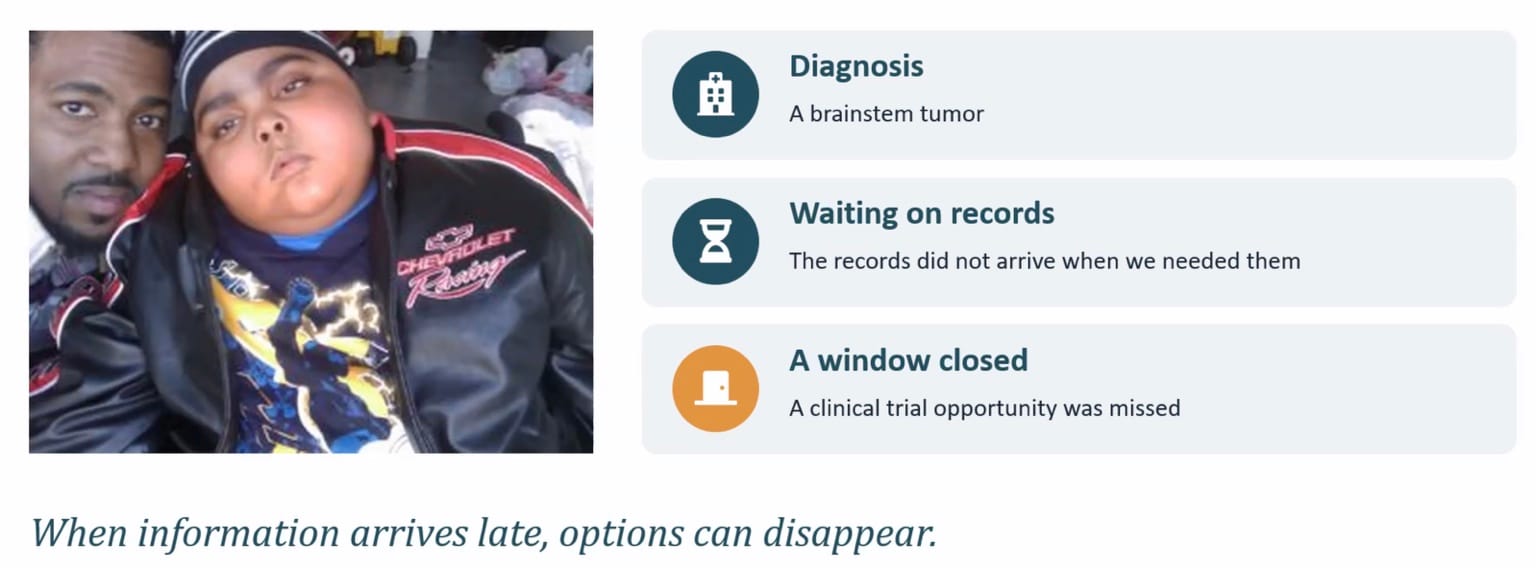
Years later, the documents had changed, but the burden of moving them still fell on the family. CJ was diagnosed with a brainstem tumor in 2008. His scans were stored on discs that had to be requested and mailed to other organizations.
Jones said delays in obtaining and transferring those records contributed to a missed clinical trial opportunity during CJ’s illness. CJ died in 2009. For Jones, that missed opportunity showed how a records transfer could become a consequential part of a family’s search for care.
“When information arrives late, options can disappear,” read the slide accompanying CJ’s story.
The experience helped motivate Jones’s work on patient access and control. His concern went beyond whether a record existed or could eventually be released. Families facing urgent decisions needed information to reach the right people while an opportunity remained available.
Ongoing care needs an ongoing conversation
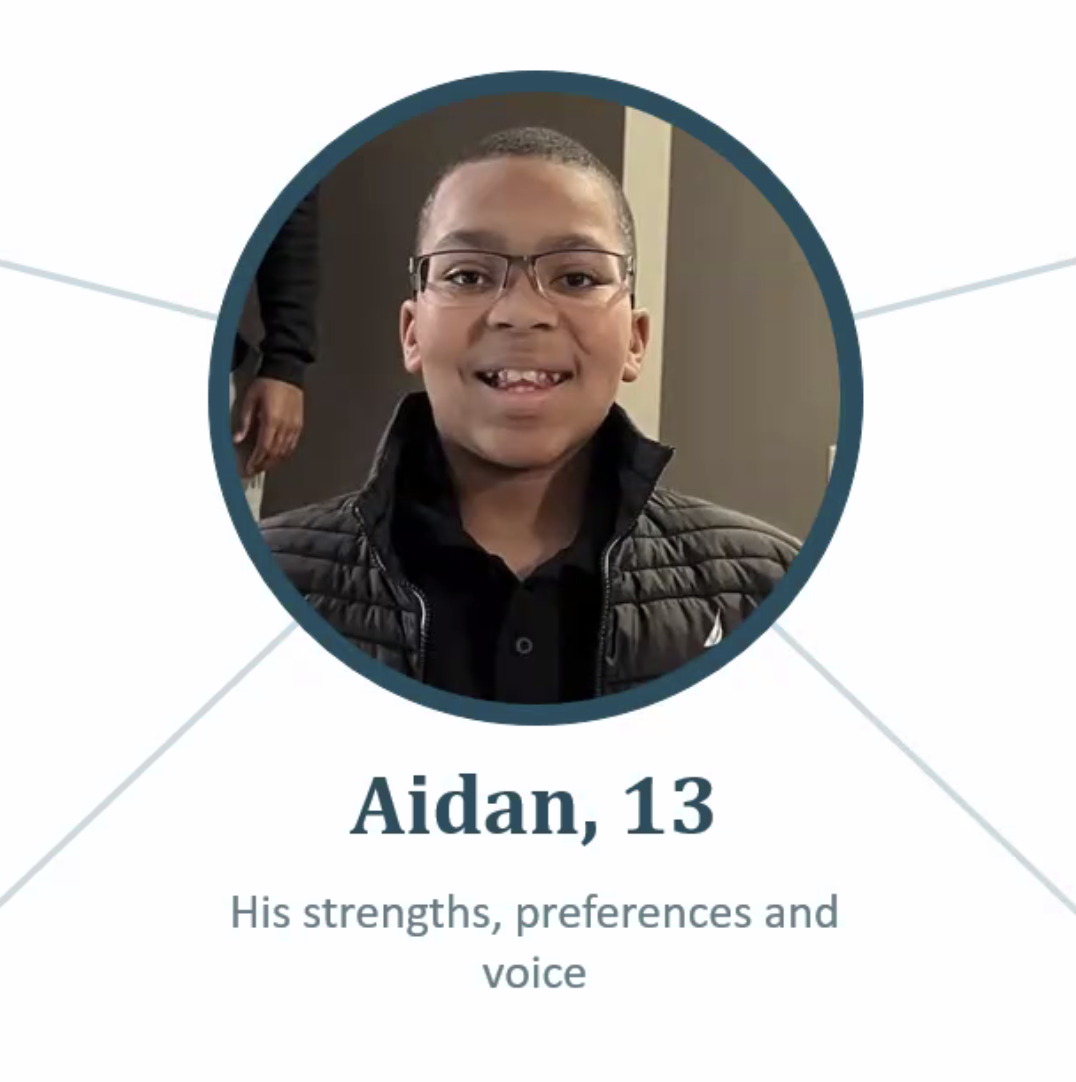
Aidan, now 13, brought another dimension to the problem. Jones described coordinating occupational therapy, speech therapy and an individualized education program at school after his son’s autism diagnosis. Information could move electronically, yet parents still had to connect what happened across those settings.
For this family, the goal includes helping Aidan communicate, navigate his environment and develop independence over time. A record of an appointment cannot fully explain how a strategy works at home, what a teacher observes or which preferences help him participate. Those details change as he grows.
“There has to be a continual loop,” Jones said. His slide placed Aidan at the center alongside “His strengths, preferences and voice.” That framing makes the person’s daily experience part of the information needed to support care.
Federal health IT guidance describes patient-generated data broadly, including information gathered by patients, family members and caregivers, such as symptoms, health history and patient-reported outcomes. Jones’s examples showed why those contributions need a dependable route into clinical conversations.
He acknowledged the progress made by portals and connected services. People can retrieve information without visiting the building where it originated. But access to a login does not establish that the information is complete, understandable or easy to contribute to. “The patient still needs to have a voice,” he said.
That concern also appears in the Sequoia Project’s consumer engagement work, which seeks to reduce the workload patients and caregivers face when accessing, using and sharing health information.
Build participation into the care process
Jones organized his approach around five steps: invite, capture, connect, respond and review. Together, they describe how a contribution can travel from a patient or caregiver to a care decision and back into an ongoing conversation.
Invite. Make clear that the patient’s priorities and the caregiver’s observations belong in the conversation. People need to know that the organization wants their contribution and offers a practical way to make it.
Capture. Provide usable ways to share information. Jones discussed text, voice and other forms of communication. The design question is whether the person can communicate what matters through the channels available to them.
Connect. Get that contribution to the people who need it, with appropriate permission. He used the relationship between Aidan’s therapists and school staff to illustrate why collecting information in separate places leaves coordination work unfinished.
Respond. Acknowledge and review what the family has contributed, then communicate the action or explanation that follows. Otherwise, the patient has supplied another piece of information without knowing whether it influenced care.
Review. Revisit the information and the response as needs change. A useful observation today may need updating later, and a previously effective approach may require adjustment.
The federal Patient Engagement Playbook supports this operational focus: practices should establish when to accept patient-generated information, who will review it and what patients should expect when they share it. AHRQ’s engagement guide similarly places patient and family participation inside concrete activities, including communication, care handoffs and discharge planning.
Plan for changing caregiver roles
Jones also challenged systems to account for changing relationships. He described the surprise his family experienced when an older son reached adulthood and his mother’s access to information required new permission. Looking ahead for Aidan raises questions about what support he will want and need as an adult.
Those transitions make authorization part of the experience of care. Systems need ways to recognize the patient’s choices, establish appropriate caregiver access and revisit arrangements as circumstances change.
The legal details depend on the situation. HHS guidance explains that a personal representative’s authority generally derives from applicable law and can be limited to particular healthcare decisions. Family involvement alone should not be treated as unrestricted authority over someone else’s information.
Jones’s broader principle was patient agency: the ability to contribute information and shape who can use it. For organizations, that means designing participation and permission together, while preserving the patient’s own preferences and voice. It also means recognizing how much coordination families already perform between visits.
Start with one patient priority
Jones’s closing recommendation was deliberately manageable: “start with one priority.” Ask before the encounter what the patient hopes to accomplish, show that priority to a team member and confirm whether it was addressed.
There is precedent for gathering that input in advance. The OpenNotes OurNotes pilot invited patients at four health systems to submit an interval history and appointment agenda for clinicians to review before or during the visit. Its design illustrates how patient contributions can become part of preparation for care.
Asked what an organization should measure during the first 90 days, Jones returned to the patient’s experience: whether care was helping, whether treatment was working and whether people felt heard. He did not offer a universal score or claim that collecting additional information alone demonstrated improvement.
A practical implication is to track what happens after a priority is submitted: whether someone reviews it, whether a response reaches the patient and whether the patient believes the concern was addressed. Those measures could help a team test its process alongside the outcomes relevant to that patient’s care.
Jones left leaders with a design question: What does the system need to know about a person that it currently has no reliable way to hear? His proposed first step makes that question actionable at the next encounter, with one expressed priority and a visible response.