Australia Sets AU Core and AUCDI as National Health Data Standards

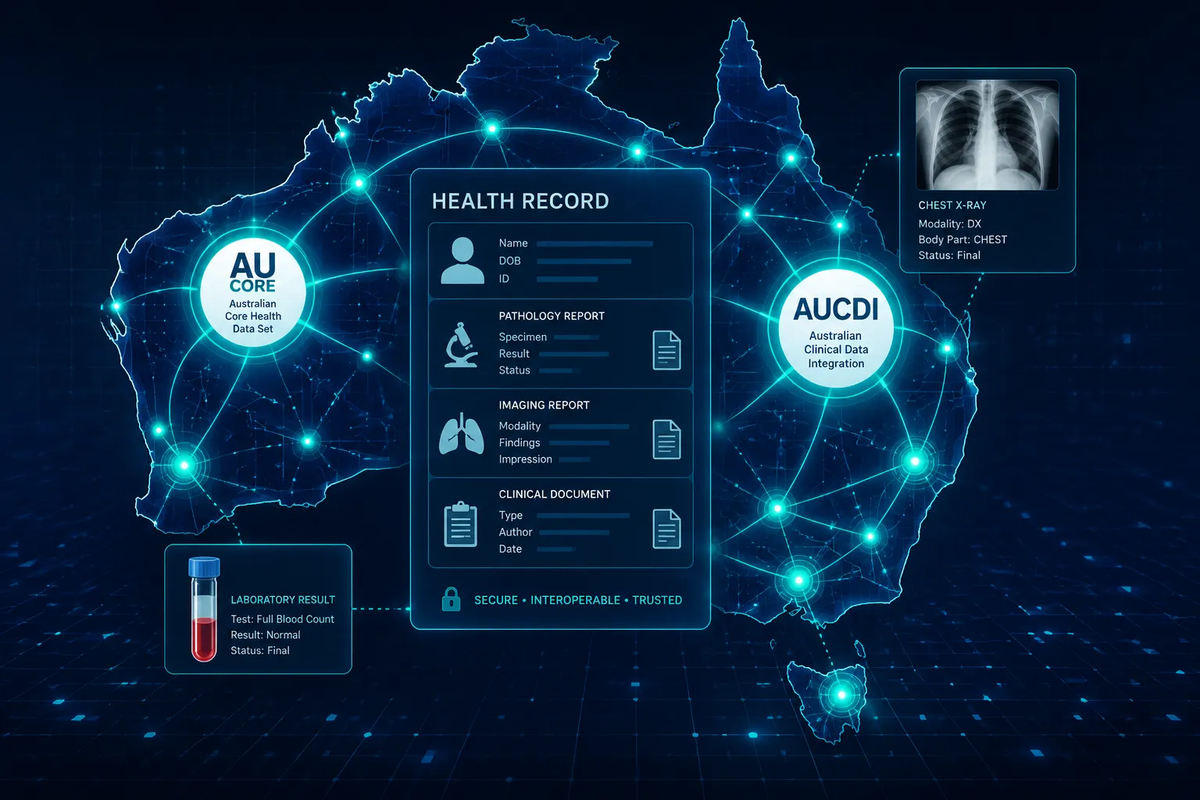
Australia has made AU Core and the Australian Core Data for Interoperability the national baseline for FHIR connections to My Health Record, a change that arrives only weeks after new rules began requiring most pathology and diagnostic-imaging reports to be uploaded to the national record by default. Together, the measures represent a significant shift in the country's digital-health strategy: from building infrastructure capable of moving clinical information toward establishing common expectations for what that information means when it arrives. The Australian Digital Health Agency framed the August change as a matter of clinical safety rather than simply technical modernization. In its announcement, the agency said the new baseline is intended to reduce inconsistency in how health information is represented, retire aging conformance arrangements and give software developers and healthcare organizations a more predictable foundation for exchanging data.
The timing matters because Australia is simultaneously increasing the amount of information flowing into My Health Record. Since July 1, pathology and diagnostic-imaging reports produced by or on behalf of pathologists and radiologists generally must be uploaded within 24 hours of being provided to a requesting clinician, another treating provider or the patient, unless an applicable exception or extension applies. The new sharing rules do not require the underlying images themselves to be uploaded, but they make clinically important reports much more likely to become available across care settings. Those reforms address related but distinct weaknesses in health information exchange: requiring more reports to be shared increases the likelihood that relevant information exists in the longitudinal record, while establishing AU Core and AUCDI as national standards is intended to increase the likelihood that receiving systems interpret that information consistently.
That distinction is increasingly important as interoperability matures. A health system can transmit enormous quantities of data while still leaving clinicians, analysts and software to reconcile inconsistent terminology, duplicated information or local variations in how the same clinical concept is represented. At relatively small scale, those differences may be manageable through manual interpretation or local translation. At national scale, however, they can become a structural source of cost, friction and clinical risk.
More data make inconsistency more consequential
My Health Record has long been intended to give Australians and authorized healthcare professionals access to information generated across multiple parts of the health system. Yet the existence of a national record has never guaranteed that every clinically relevant result would appear there. The July rules change the default for pathology and diagnostic imaging, making reports that might previously have remained inside the originating organization's systems more likely to become part of the national record. That can make recent laboratory findings, radiology interpretations and other diagnostic information easier to retrieve when patients move among hospitals, specialists, primary-care providers and other services.
Patients also gain greater access. Many reports can be viewed through My Health Record or the 1800MEDICARE application, although specified categories of information — including many anatomical pathology, cytopathology, genetic-testing and advanced-imaging reports — remain subject to delayed release intended to preserve an opportunity for appropriate clinical communication. Greater availability, however, magnifies another problem: the more information healthcare systems exchange, the more important it becomes that they agree on how the data are represented. A laboratory result that is visible to a clinician may still be usable even if the underlying data structure varies, but an analytics platform, clinical-decision-support system or AI application cannot rely on human interpretation in the same way.
Software needs consistent identifiers, terminology, units, metadata and relationships among clinical concepts before it can safely treat information from separate sources as equivalent. At relatively small scale, organizations can build translations around those differences, but at national scale the accumulation of local variations becomes costly and potentially unsafe. Australia's latest standards effort is aimed directly at that problem. It is not simply an effort to increase the quantity of information available; it is an attempt to improve the consistency with which that information can be understood and reused.
FHIR provides the language; AU Core narrows the dialect
Fast Healthcare Interoperability Resources, commonly known as FHIR, has become one of the most important standards for modern healthcare data exchange. Instead of treating the medical record as one large document, FHIR organizes information into reusable resources representing concepts such as patients, observations, medications, encounters and diagnostic reports. Its flexibility is a major reason for its adoption, because organizations can implement the standard across many different technical environments. That same flexibility, however, is also one of the reasons two organizations can truthfully say they support FHIR and still struggle to exchange information seamlessly.
FHIR allows considerable implementation choice. Different developers can represent similar concepts in different ways while remaining technically compliant with the broader standard, which is why implementation guides are necessary to reduce variation for a particular country, program or use case. AU Core performs that function for Australia. The current implementation guide, developed through HL7 Australia, establishes a minimum set of FHIR expectations for commonly exchanged Australian clinical information, while AUCDI addresses a related but different problem by defining core clinical data concepts that Australian systems should be able to capture, represent and share.
The distinction matters because AUCDI is principally concerned with the information itself, while AU Core provides technical guidance for representing much of that information through FHIR. A blood-pressure observation, for example, is not useful merely because one system can send a field labeled “blood pressure.” The receiving system needs enough shared understanding of the observation, its values, units, patient association and related metadata to recognize it reliably as the same clinical concept. That is the difference between transporting information and achieving semantic interoperability.
Retiring legacy requirements could reduce years of accumulated complexity
Australia is not implementing these standards on a blank technological landscape. Hospitals, laboratories, diagnostic-imaging providers, primary-care practices and software companies already operate functioning systems built around earlier generations of conformance requirements and interfaces. The Australian Digital Health Agency therefore plans to retire outdated Healthcare Identifiers and My Health Record conformance profiles while moving organizations away from older versions of the Healthcare Information Provider Service through staged transition arrangements. That gradual approach reflects one of the central difficulties of healthcare modernization: legacy systems usually remain in place because they work.
Organizations have invested heavily in those systems, vendors support customers running different generations of software, and replacing an interface can create testing requirements, operational risk and cost even when the replacement is technically superior. The burden appears over time as complexity accumulates. Every outdated profile or local variation becomes another configuration a vendor must maintain and another interpretation a receiving application may need to understand. An interoperability architecture intended to simplify exchange can gradually turn into a collection of translations between historical implementations.
Moving toward a stronger national baseline can reduce that burden, but only if the migration does not disrupt functioning clinical exchange. A national modernization effort that temporarily makes information less available would undermine its own purpose, which is why staged transition is more than a technical convenience. It reflects the difference between publishing a new specification and safely moving a healthcare system onto it. For software suppliers in particular, the transition creates a period in which they may need to support both worlds, keeping older services functioning while rebuilding toward the national FHIR baseline.
Standardization cannot make inaccurate data correct
The move toward AU Core and AUCDI could make Australian health information more consistent, but it cannot make the underlying information inherently accurate. A medication can be encoded perfectly and still be outdated, a pathology result can use the correct terminology but be associated with the wrong patient, and a diagnosis can be structurally valid while remaining uncertain or provisional. Interoperability improves the reach of information, which means it can amplify good information and poor information alike. That is one reason the Australian Digital Health Agency has connected the standards effort explicitly with clinical governance and safety.
Receiving systems need enough context to understand where information originated, when it was recorded and whether newer information may supersede it. The problem becomes more important as software begins doing more than displaying the record, because a clinician reading several notes may recognize that two diagnoses conflict or that a medication list appears outdated while a population-health algorithm or AI system may treat a structured field as authoritative unless provenance, timing and uncertainty have been represented sufficiently well. Standardization therefore needs to operate alongside data-quality controls rather than replace them. The safest national information environment is not one in which every clinical fact has merely been converted into a structured field, but one in which receiving clinicians and systems can judge how much confidence to place in that field.
Faster patient access creates a new responsibility for follow-up
The new sharing rules also change the relationship between the medical record and the patient. Making pathology and imaging reports more consistently available can improve transparency and reduce dependence on a single provider to retrieve information, particularly for patients who receive care from multiple organizations. Greater access, however, does not eliminate the need for clinical interpretation. A pathology result can be completely accurate and still be difficult for a patient to understand, because the language of radiology and laboratory medicine frequently includes qualifications, differential possibilities and findings whose significance depends on symptoms, prior testing and other clinical context.
Australia's delayed-release provisions for specified reports recognize that distinction by creating time for communication in situations where immediate electronic access may not be the most appropriate first encounter with the information. For healthcare organizations, that creates a workflow question as important as the technical one. If results appear in the national record more quickly and consistently, systems need reliable processes for ensuring that significant findings are communicated, acknowledged and acted upon. Uploading a result cannot become a substitute for closing the clinical loop, because a national record can make the result visible without determining who owns the response.
That distinction between information access and care coordination will become increasingly important as patients gain more direct access to the same data their clinicians use. Faster access can strengthen patient engagement, but it also makes timing, communication and accountability more visible. If a report appears before a clinician has reviewed it, the system needs to account for that possibility. If a significant result becomes available across multiple settings, responsibility for follow-up still has to be explicit rather than assumed.
The next test is what becomes unnecessary
Australia's reforms are significant because they address two weaknesses that often emerge at different stages of digital maturity. Early interoperability programs struggle to make systems connect at all, while more mature ones discover that connectivity alone does not eliminate fragmentation if the information moving across those connections lacks consistent meaning. Australia is now trying to advance both availability and computability at the same time by requiring more diagnostic information to enter My Health Record while establishing AU Core and AUCDI as the national baseline for how increasingly structured information should be represented and exchanged. That combination moves the country's interoperability strategy beyond simple connectivity and toward a more demanding test of whether information can be reused safely.
Neither reform, by itself, proves that care will improve. The stronger evidence will emerge in what becomes less necessary afterward: fewer missing reports, fewer duplicate tests, less manual reconciliation, safer transitions between providers, more portable digital applications and less vendor-specific translation work. Those outcomes are more difficult to count than API connections or uploaded documents, but they are also much closer to the reason interoperability exists. A successful national data standard should eventually be visible not simply in the number of systems connected, but in the amount of friction removed from care.
Australia has reached a stage at which simply moving more health information is no longer an adequate measure of success. The more demanding standard is whether that information can follow a patient across the healthcare system, retain its clinical meaning and remain usable by both people and software without recreating the fragmentation that national exchange was intended to solve. If AU Core and AUCDI succeed, their significance will not lie in the specifications themselves. It will lie in how rarely clinicians, patients and software have to notice the boundaries those standards were designed to bridge.