ASEAN and U.S. Expand Genomic Surveillance for Emerging Diseases
ASEAN and the United States agreed to link early detection, genomic surveillance, big-data analytics and One Health. The 2027–2030 work plan will show whether uneven laboratory capacity can become a durable regional warning system.

Eleven Southeast Asian governments and the United States agreed on September 11 to deepen cooperation in four connected capabilities—early detection, pathogen genomic surveillance, big-data analytics and One Health—at the first ASEAN–U.S. Health Ministers’ Meeting in Kuala Lumpur. The new agreement also directs support toward two regional institutions: the ASEAN Centre for Public Health Emergencies and Emerging Diseases, known as ACPHEED, and the ASEAN Public Health Emergency Coordination System, or APHECS. Ministers began shaping a successor cooperation plan for 2027–2030, aligning it with the newly launched ASEAN Strategic Health Agenda for the same period.
The commitment treats sequencing and analytics as parts of a regional warning system rather than isolated laboratory projects. A pathogen genome can identify a new lineage, connect infections or show resistance mutations, but only if samples, epidemiological records and analysis reach decision-makers in time. The declaration is therefore a starting point, not evidence that ASEAN already has a seamless surveillance network. The test will be whether laboratories with sharply different resources can share comparable, timely intelligence.
That implementation challenge is visible in the region’s existing data. A peer-reviewed regional assessment of 42 institutions in 13 South and Southeast Asian countries found that every country had next-generation sequencing capacity, yet only seven had national plans integrating pathogen genomics into broader surveillance. The study estimated a median 18-day interval from sample collection to sequence reporting, a delay that can reduce the value of genomics during a fast-moving outbreak. ASEAN and its U.S. partner are now attempting to turn uneven capacity into a system that can detect threats earlier and coordinate action across borders.
A Regional Architecture Takes Shape
The decision fits within a broader restructuring of ASEAN health cooperation after COVID-19. Malaysia’s health minister, Dzulkefly Ahmad, said the five-year agenda is organized around four clusters: healthy lifestyles and noncommunicable disease prevention; all-hazards and emerging-threat response; stronger health systems and access; and regional food safety. Genomic surveillance sits primarily in the second cluster, but human, animal, food and environmental observations must be linked to trace zoonotic infections or antimicrobial resistance.
ASEAN is not beginning with a blank sheet. Its Biological Threats Surveillance Centre operates a regional dashboard that combines government, World Health Organization and other data and applies visualization and geographic analysis. Singapore’s health ministry said in a parliamentary response updated September 12 that the centre and the ASEAN Emergency Operations Centre Network already enable member states to share communicable-disease intelligence. It also said national laboratories exchange technical experience, reference materials and confirmatory testing support.
APHECS is intended to supply an operational framework for a unified, multisector response. The U.S. mission described it as a way to clarify coordination across the full emergency cycle. ACPHEED is designed as the permanent center of expertise, with functions distributed across Indonesia, Thailand and Vietnam. A sequence has limited value if no institution can validate the signal, combine it with field reports and coordinate a cross-border decision.
Sequencing Is Only the First Step
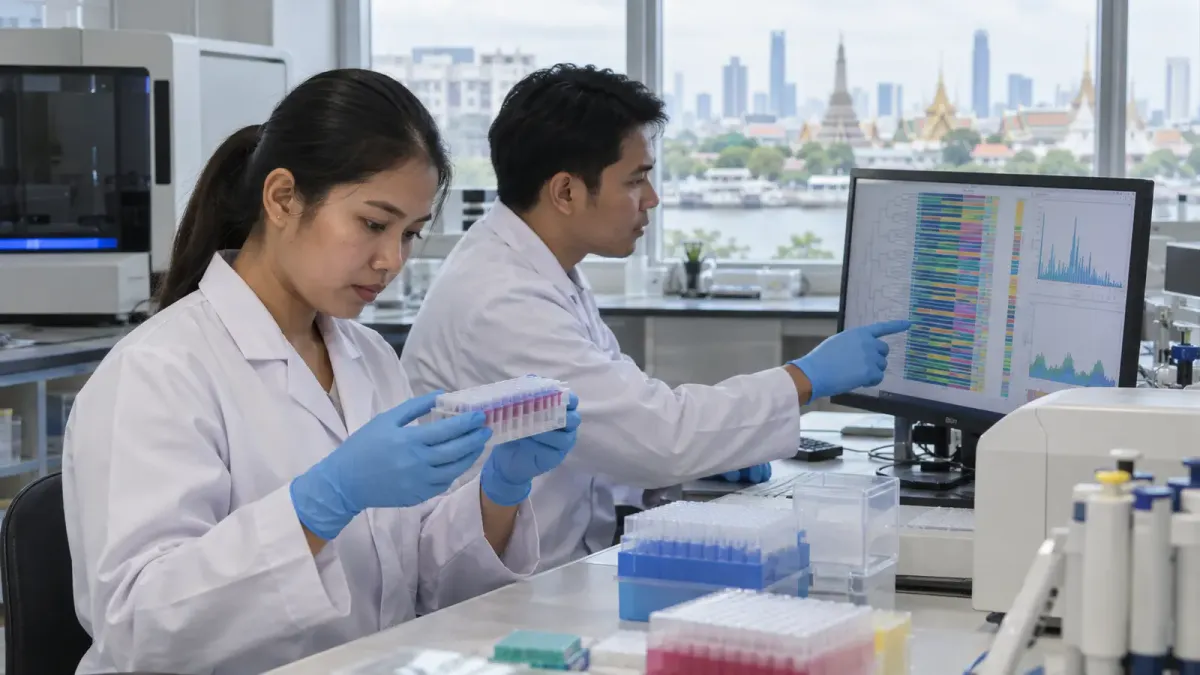
Genomic surveillance begins with material collected through ordinary public-health systems: clinical samples, wastewater, food testing or animal-health investigations. Laboratories extract and sequence genetic material, compare it with known pathogens, then combine the result with time, location and clinical data. That process can reveal whether cases share a transmission chain, whether a virus is changing or whether bacteria carry genes associated with drug resistance. It does not, by itself, determine how severe an outbreak will be or prove where a pathogen originated.
The World Health Organization’s global strategy makes that distinction explicit. It calls for sequencing to reinforce an end-to-end system covering sample collection, diagnostics, analysis and data sharing, with timely access for all 194 WHO member states by 2032. For ASEAN, the important word is timely. A technically accurate result delivered weeks after local transmission accelerates may be useful for research but too late to guide containment, clinical alerts or procurement.
The 13-country assessment found routine sequencing was relatively common for coronaviruses and influenza, but much less developed at the human–animal and environmental interfaces. Only seven of the 13 countries surveyed used next-generation sequencing on animal or environmental samples when investigating unknown pathogens. That gap helps explain why the ministers paired genomics with One Health. The global joint plan developed by WHO, the Food and Agriculture Organization, the UN Environment Programme and the World Organisation for Animal Health treats cross-sector governance and data systems as necessary infrastructure, not optional additions.
Supply Chains Could Set the Pace
The largest obstacles are often operational rather than scientific. A 2026 supply-chain study involving 42 partners across 13 countries, three sequencing manufacturers and 22 laboratory staff found procurement problems in every country and across all sequencing platforms examined. High equipment and consumable costs were reported by 85% of respondents. Reagent resupply problems affected 77% of countries, with a mean wait of eight weeks; 69% reported long equipment-purchasing lead times.
Those numbers define the practical boundary of a regional network. A laboratory may own a sequencer yet be unable to run it when cartridges are held in customs, a service contract lapses or a reagent expires in transit. The earlier assessment found laboratories used only 51% of maximum monthly capacity. External donors supplied 57% of surveillance resources and public-sector sources 32%, leaving programs vulnerable when emergency grants end.
A durable 2027–2030 work plan would therefore need to address pooled procurement, regional maintenance, customs procedures, quality assurance and workforce retention alongside data platforms. Manufacturers told the supply-chain researchers that they were using regional hubs, distributor networks and financing arrangements to reduce bottlenecks, but the study did not test whether those measures shortened reporting times. Ministerial endorsement can align priorities; it cannot substitute for recurring national budgets, trained bioinformaticians or reliable cold-chain and computing capacity.
Data Sharing Requires Governance
Faster exchange also creates governance questions. A genomic record is most useful when paired with basic metadata such as collection date, geography, specimen type and relevant clinical or epidemiological context. Yet inconsistent definitions and reporting practices can make results difficult to compare. The ASEAN dashboard itself cautions that differences in case detection, laboratory testing and reporting methods can produce discrepancies across its sources. Interoperability will require common fields, quality checks and transparent rules for correcting data.
Access rules matter as well. WHO’s 2025 platform guidance says repositories differ in accepted metadata, curation and access policies, and calls for sharing arrangements that are effective, timely and equitable. Pathogen sequences generally describe microbes, but raw files can contain incidental human genetic material, and detailed place or host data can expose communities or industries to stigma and economic harm. Governments also want recognition and fair access to resulting diagnostics, vaccines and treatments when they share samples and sequences.
The United States brings both technical expertise and a working example of travel-linked monitoring. The CDC program uses voluntary nasal samples from arriving international travelers and wastewater collected from aircraft or airport systems to look for communicable-disease signals. That model shows how travel and genomic data can complement domestic surveillance, but it is not a template that can simply be copied across ASEAN. Member states have different privacy laws, laboratory networks, border volumes and public-health authorities.
The Work Plan Will Be the First Test
The next consequential document will be the ASEAN–U.S. Health Cooperation Work Plan for 2027–2030. The ministerial statement names the tools and institutions, but the work plan can turn them into measurable obligations: which pathogens receive priority, how quickly unusual findings should be reported, what metadata accompany sequences, when confirmatory testing is shared and how lower-capacity laboratories receive support. Targets for turnaround time, reagent availability and routine use would make progress visible in a way that broad commitments cannot.
Singapore’s health minister, Ong Ye Kung, framed the larger agenda around noncommunicable disease, antimicrobial resistance and a future “Disease X.” In his ministerial speech, he argued that ASEAN should map vaccine needs, technology platforms, manufacturing capacity and regulatory readiness before the next emergency. Genomic surveillance is the upstream information layer for that planning: it can identify a threat and characterize its evolution, while manufacturing and response systems determine whether the information changes outcomes.
The September 11 agreement establishes a direction, not a finished network. ASEAN has laboratories, dashboards and coordination mechanisms, and the United States has committed to support greater integration. Evidence also shows underused equipment, slow reporting, fragmented environmental surveillance and dependence on external financing. Success will be measurable in the interval between sample collection, shared analysis and public-health action—and in whether improvements persist after political attention fades.