Anthropic Builds Wet Lab to Connect Claude With Biology
Anthropic has opened a San Francisco Bay Area wet lab to connect Claude with physical biology experiments. The move could shorten research cycles, but the company has disclosed no results and does not plan to run clinical trials.
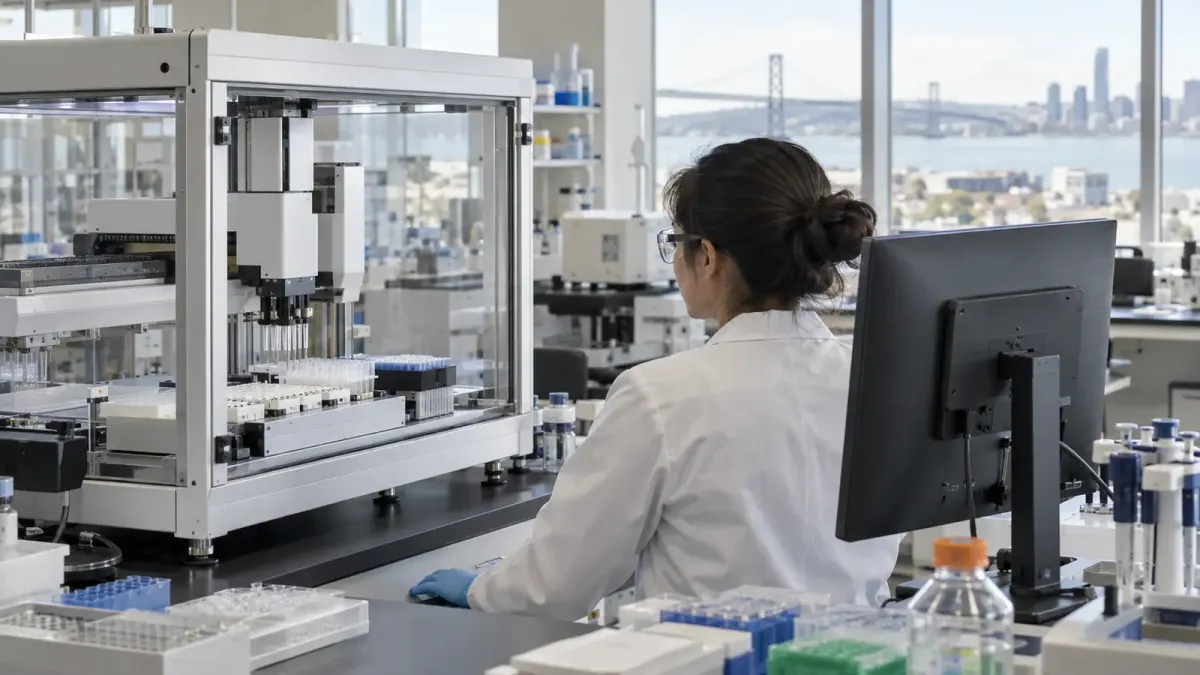
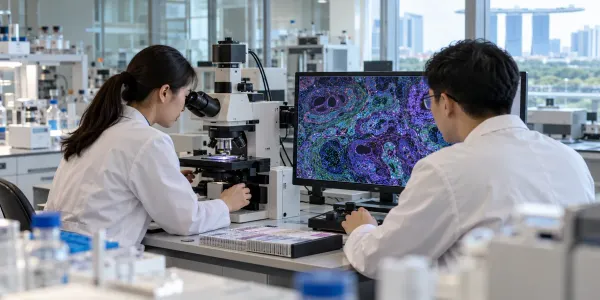
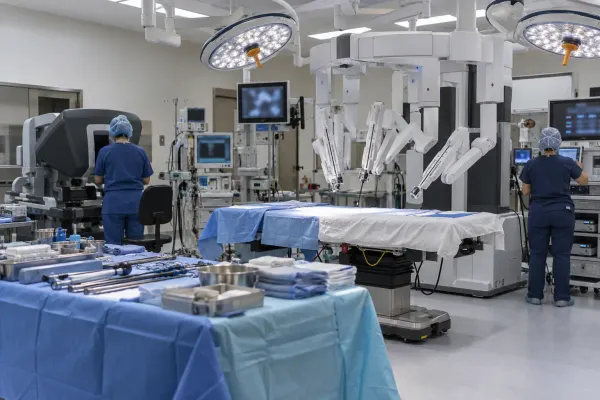
Anthropic has opened a wet laboratory in the San Francisco Bay Area and is beginning physical biology experiments, moving its life-sciences program beyond computer analysis and into the environment where hypotheses are tested against living systems. The company’s head of life sciences, Eric Kauderer-Abrams, confirmed the facility in a Reuters interview published Friday, saying Anthropic is combining work in its own facilities with experiments conducted by outside partners. The laboratory is not specifically a drug-discovery operation, a company spokesperson cautioned, and Anthropic has not disclosed its size, equipment, research targets or experimental results.
The move is consequential because it gives a leading artificial-intelligence developer direct access to the feedback loop that determines whether a computational idea survives contact with biology. Anthropic has said it wants its Claude system to help plan research, analyze data and eventually operate laboratory equipment, particularly for diseases that attract too little commercial investment. A wet lab can shorten the distance between a model’s proposed experiment and the evidence needed to reject, refine or advance it. It cannot establish that Claude will discover viable medicines, and Anthropic says it does not intend to run clinical trials.
Closing the loop between software and experiments
Generative AI can search literature, write analysis code and propose testable ideas, but biology ultimately depends on measurements made in cells, tissues, organisms and patients. Anthropic’s existing life-sciences platform connects Claude to sources and tools including PubMed, Benchling, 10x Genomics, Synapse and scientific computing environments. Those connections let researchers retrieve papers, inspect experimental records and analyze genomic data without moving manually among as many systems. The new facility adds the possibility of obtaining fresh experimental results, rather than limiting Claude to records generated elsewhere.
A closed-loop laboratory links four functions: choosing an experiment, translating the plan into machine-readable instructions, executing it on automated instruments and using the data to select the next test. Samples and instruments must be identified consistently, protocols need version control, and every model-generated decision should be traceable. Without that provenance, speed can amplify errors as readily as discovery.
Anthropic has already introduced a research preview called the Model Hardware Standard, which is meant to let AI agents communicate with programmable microscopes, robotic arms and other equipment. The company told Reuters in August that it was testing the framework with selected partners before a planned open-source release. The wet lab gives Anthropic a controlled setting in which to test whether those interfaces work reliably under real laboratory conditions, where calibration drift, contaminated samples and incomplete metadata can defeat an apparently sound plan.
A shift from assistant to research operator
The laboratory is part of a broader effort to make Claude an active participant in research rather than a conversational layer over documents. Anthropic says life sciences is now one of its largest investment areas. It has acquired Coefficient Bio, developed Claude Science and recruited specialists in protein and nucleic-acid characterization. The company says its preclinical work will focus on neglected or technically difficult areas instead of competing with drugmakers that take products through human trials.
That boundary is important but not simple. An AI provider that performs experiments can learn which prompts, instrument configurations and analytical workflows produce useful results, improving its product for customers. At the same time, pharmaceutical clients may worry that a vendor with its own laboratory is moving closer to their proprietary discovery process. Anthropic says customer data are segregated, yet laboratories will need contractual and technical controls governing what models retain, which results can be reused and how confidential experimental records move through shared infrastructure.
The company’s wider research operations show how quickly its systems are taking on more work. Anthropic recently said Claude contributes directly to 26% of its model research and collaborates on roughly 90% of research-and-development tasks, while remaining under human supervision, according to the Associated Press. Those figures describe participation, not independent scientific judgment. Still, they suggest the organization is building operational experience with large populations of agents before extending similar patterns into experimental science.
What faster experimentation could change
The immediate opportunity is throughput. Automated laboratories can run repetitive assays around the clock, while an AI system compares new data with literature and prior experiments. That may help in early discovery, where researchers screen many molecular designs and abandon most candidates. Anthropic has pointed to complex antibodies as one area where computational design and rapid testing could explore combinations that are expensive to evaluate manually.
Work elsewhere also shows that language models can connect scientific publications to executable research tools. A peer-reviewed Nature study published last week described Paper2Agent, a system that converts papers, associated code and data into interactive agents capable of reproducing results and answering new questions. That approach concerns computational reproducibility, not wet-lab autonomy, but it illustrates a related shift: scientific knowledge is being packaged so an AI system can act on it rather than merely summarize it.
The strongest gains may come from reducing delays between stages rather than producing an autonomous discovery. A model-drafted protocol still needs scientific review, a robot needs controls and maintenance, and a promising signal needs replication. Integration could compress those handoffs and preserve a clearer record of why each experiment occurred. Better medicines still depend on biological validity, not experiment volume.
Evidence remains far behind ambition
Anthropic has not released laboratory performance data, named a disease program or reported a candidate molecule. There is no basis yet to compare its system with conventional teams on reproducibility, cost or scientific quality. The facility is infrastructure and organizational commitment, not evidence of a therapeutic result. Even successful preclinical work remains separated from an approved treatment by manufacturing, toxicology studies and human research.
The U.S. clinical-research system is designed to answer questions that a wet lab cannot. Early trials examine safety and dosing, later trials test effectiveness and less common harms, and regulators evaluate whether benefits outweigh risks for a defined population. The FDA process also requires protocols, informed consent and oversight that cannot be replaced by faster hypothesis generation. Anthropic’s decision not to run clinical trials keeps it upstream from those responsibilities, while leaving partners to carry any promising work through the most expensive and consequential stages.
Automation can also create systematic failure modes. A faulty instrument interface, mislabeled sample or confident but incorrect model inference could contaminate a sequence of dependent experiments before a person notices. Robust deployments will require physical interlocks, access controls, audit logs, independent replication and predefined conditions for human intervention. Laboratory leaders will need evidence that the system can recognize uncertainty and stop safely, not only demonstrations that it can complete a protocol under ideal conditions.
Biological capability raises a dual-use test
Anthropic is expanding biological capability while publicly warning that advanced models can lower barriers to harmful biological work. Its scaling policy ties stronger safeguards to evidence that a model could materially assist severe chemical, biological, radiological or nuclear threats. Connecting an agent to laboratory hardware changes the risk analysis because software output can become physical action. Even when the intended work concerns medicines, permissions must limit which protocols, organisms, reagents and equipment an agent can access.
The company says human oversight remains essential, but its operational meaning will determine its value. A person who merely approves a queue of machine-generated actions may not provide meaningful review. Strong governance would separate proposal, authorization and execution, require extra review for higher-risk work and preserve records detailed enough to reconstruct an experiment. Partners also need clarity about accountability when a model, robot and third-party protocol interact.
The next evidence to watch
Anthropic’s wet lab narrows the gap between general-purpose AI and experimental biology, but it establishes capacity for physical work, not the work’s value. Useful benchmarks would show whether model-designed experiments replicate, how much time or cost is saved, and how often humans override proposed actions. Comparisons should use the same scientific task and include failures, not only selected demonstrations.
The larger test is whether Anthropic can build a trustworthy experimental record while serving companies that may also view it as a potential competitor. If its laboratory produces reproducible gains with clear data governance and safety controls, the project could become an important bridge between AI reasoning and biological evidence. If details and results remain opaque, it will be difficult to distinguish a durable research platform from an expensive demonstration of automation. For now, the lab is a meaningful change in where Anthropic works, while its effect on medicine remains unproven.