Adam Cherrington Outlines Four Conditions for Patient Trust in the AI Era
At HealthDataCon 2026, Adam Cherrington connected information, response, access and relationships in a framework for building patient trust when AI-generated answers enter the clinical conversation.


When a patient brings an AI-generated answer into an appointment, the clinician’s response can shape more than the immediate discussion. It can determine whether that patient feels comfortable sharing the next question, concern or conflicting recommendation.
At HealthDataCon 2026, Adam Cherrington urged healthcare leaders to treat that encounter as an opportunity to strengthen a relationship. Patients are already using AI to navigate symptoms, treatment information and a system that can be difficult to reach. Telling them to stop, he argued, does little to address the reasons they started.
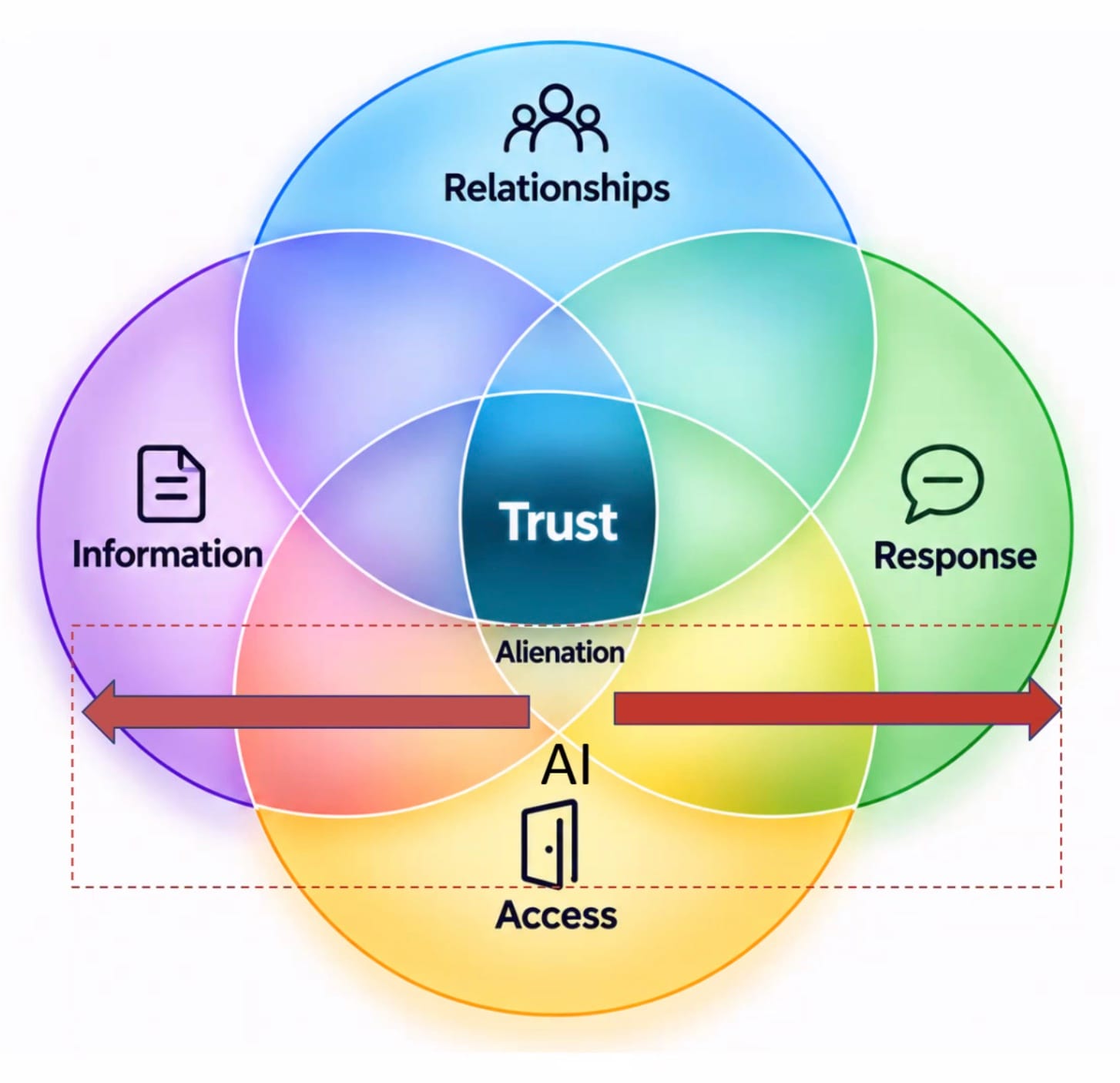
His proposed framework, “trust math,” connects four conditions: information, response, access and relationships. Its practical emphasis is on what clinicians and organizations can do when patients arrive with information gathered elsewhere. The framework is a working model for discussion, not a validated equation that predicts trust or clinical outcomes.
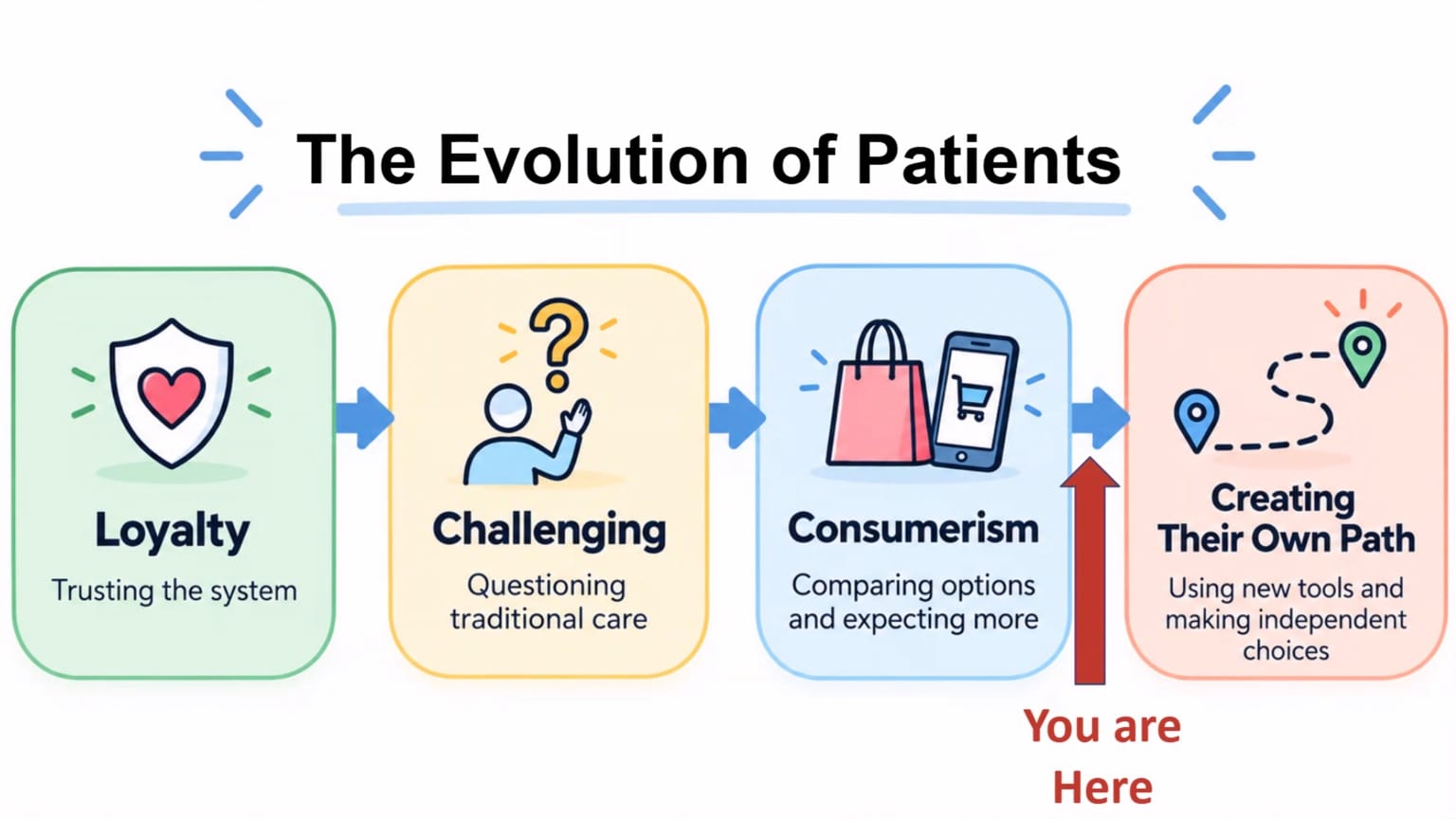
Patients are finding their own route
Cherrington described an evolution from relying on an institution’s reputation toward comparing services and creating personal workarounds. Experiences with other industries shape expectations about convenience and responsiveness, even when patients recognize that healthcare is more complicated than booking travel or ordering a product.
“Patients are creating their own path,” he said. Sometimes healthcare workers help them navigate the very systems in which those workers practice. That observation placed the discussion of AI inside a larger access problem: patients still need understandable answers while they wait for the next available interaction.
There is evidence that chatbot use is expanding. Rock Health’s consumer survey, fielded in December 2025 among 8,000 U.S. Census-matched adults, found that 32% reported ever using AI chatbots for health information, compared with 16% a year earlier.
Among respondents who had used those tools for health information, 59% had explored treatment options based on a diagnosis, 56% had searched for a diagnosis based on symptoms and 55% had researched prescription drugs or side effects. Those percentages describe AI health users, rather than the entire survey population.
For Cherrington, the significance was the range of questions entering the conversation before an appointment begins. A patient may be comparing explanations, preparing questions or trying to decide whether to seek care. The clinician needs to understand which of those tasks the patient was attempting.
Use is not the same as trust
Cherrington highlighted a tension: people can be uncertain about AI’s accuracy and still act on its responses. A Gallup report published in April 2026 illustrates that distinction. Among people who had used AI for health information or advice in the previous 30 days, only 4% strongly trusted its accuracy.
That does not mean everyone else distrusted it. In the same group, 33% expressed trust overall, 33% neither trusted nor distrusted it, and 34% distrusted it. Fourteen percent of recent users said AI information or advice had led them to skip a provider visit in the previous 30 days. The survey establishes reported behavior; it does not establish whether those skipped visits were medically appropriate.
Cherrington also revisited a 2025 report he coauthored, based on a nationwide survey of 1,006 patients that July. In his presentation, he described greater comfort with administrative uses such as scheduling than with clinical applications, alongside a continuing desire for human oversight.
These findings measure different things: comfort with an organization using AI, personal use of a chatbot and confidence in its answers. They should not be treated as a single measure of trust moving uniformly over time. Cherrington’s central concern was that use can influence decisions even while confidence remains qualified.
He also cautioned against predicting an individual patient’s technology habits from age alone. Asking about actual use gives a care team more useful information than assuming that a younger patient relies on AI or that an older patient avoids it.
Four conditions for trust
In Cherrington’s model, information helps patients understand their situation; response shows that someone is attending to their concern; access makes help reachable; and relationships provide a human connection. Trust grows when those conditions reinforce one another.
The absence of one condition can change the experience. A patient may have an established clinician, useful information and an appointment pathway, yet feel abandoned when no one responds. Another may receive quick answers and obtain services but feel alienated because the relationship is weak.
Cherrington placed AI’s immediate appeal around information, response and access. A chatbot can respond while a clinical team is unavailable. But fast access to an answer does not itself provide access to medical care, and responsiveness does not establish accuracy. His framework directs attention to what remains missing from the patient’s experience.
He expressed the model through six proposed “laws.” Frustration reflects the gap between expectations and experience. AI’s availability helps explain its appeal. AI combined with curiosity can help a patient prepare. A collaborative clinician response can strengthen trust. Information, validation and guidance can build confidence. Trust reinforced by consistency can support loyalty.
These are conceptual relationships, not measured mathematical effects. Their usefulness lies in prompting specific questions: Is the patient missing information? Has a request gone unanswered? Is access blocked? Has the person’s effort to understand been acknowledged?
A collaborative clinical response
During the session, Kenneth R. Deans Jr. asked how a clinician could challenge an inaccurate AI answer without embarrassing a patient or discouraging future disclosure. Cherrington’s answer centered on curious listening, validation and guidance. Validation, in this context, means recognizing the patient’s effort and concern; it need not mean endorsing the chatbot’s conclusion.
He illustrated the approach through physician Nathan Merriman, whom he described as inviting patients to explain the prompts they used and reviewing their questions together. Asking what the patient entered can reveal missing context, an unclear question or the particular claim that caused concern.
Cherrington recounted Merriman’s distinction between a tool and a caring professional: “AI doesn’t care about you. That’s my job.” The point was the clinician’s continuing responsibility to engage with the person behind the question, rather than treating the encounter as a competition over who supplied the answer.
That collaboration must still include scrutiny. The World Health Organization’s AI guidance warns that generative systems can produce inaccurate, biased or incomplete statements that harm people making health decisions. A persuasive explanation therefore needs evaluation against relevant evidence and the patient’s circumstances.
Deans also asked about situations in which evidence remains uncertain. Cherrington returned to collaboration. NICE’s decision-making guidance similarly emphasizes explaining uncertainty around estimates so people can understand what the information means for them. Acknowledging limits can preserve an honest discussion without manufacturing a definitive answer.
Make trust a repeatable experience
Cherrington distinguished confidence from trust and trust from loyalty. A person may feel more informed after reading an answer. Trust also concerns the relationship through which that information is evaluated. Loyalty, in his framework, depends on consistent experiences over time.
The approach connects with established shared decision-making practice. AHRQ’s SHARE Approach structures dialogue around the benefits, harms and risks of options and what matters most to the patient. AI introduces another source of information into that dialogue; it does not remove the need to understand the person’s priorities.
For organizations, Cherrington’s model also reaches beyond the consultation. Encouraging patients to ask questions will have limited effect if calls go unanswered or access remains difficult. Improving the relationship requires attention to the surrounding experience as well as the language used in the room.
He urged participants to bring the issue back to their teams and acknowledge why patients seek immediate answers. The practical opportunity is to make those searches discussable, evaluate the information together and respond consistently. As Cherrington put it, “We can choose to increase trust.”